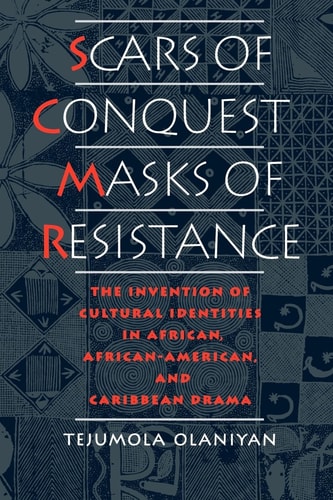
Scars of Conquest/Masks of Resistance: The Invention of Cultural Identities in African, African-American, and Caribbean Drama
0
0
As an Amazon Associate and affiliate partner, Menrva Books earns from qualifying purchases. Learn more
Author Description
This original work redefines and broadens our understanding of the drama of the English-speaking African diaspora. Looking closely at the work of Amiri Baraka, Nobel prize-winners Wole Soyinka and Derek Walcott, and Ntozake Shange, the author contends that the refashioning of the collective cultural self in black drama originates from the complex intersection of three discourses: Eurocentric, Afrocentric, and Post-Afrocentric.From blackface minstrelsy to the Trinidad Carnival, from the Black Aesthetic to the South African Black Consciousness theatres and the scholarly debate on the (non)existence of African drama, Olaniyan cogently maps the terrains of a cultural struggle and underscores a peculiar situation in which the inferiorization of black performance forms is most often a shorthand for subordinating black culture and corporeality.Drawing on insights from contemporary theory and cultural studies, and offering detailed readings of the above writers, Olaniyan shows how they occupy the interface between the Afrocentric and a liberating Post-Afrocentric space where black theatrical-cultural difference could be envisioned as a site of multiple articulations: race, class, gender, genre, and language.
Menrva's Summary
THE THESIS
This work investigates how playwrights within the English-speaking African diaspora construct and negotiate cultural identity through the intersection of Eurocentric, Afrocentric, and Post-Afrocentric discourses. Tejumola Olaniyan, a scholar of African and African-American literature, utilizes a framework of cultural studies to analyze how black drama functions as a site of resistance against the historical inferiorization of black performance. By examining the interplay between race, class, and gender, the author argues that these dramatists move beyond binary oppositions to create a liberating, multifaceted space for cultural expression.
THE SCOPE MAP
What You Will Find
- Analysis of major playwrights including Amiri Baraka, Wole Soyinka, Derek Walcott, and Ntozake Shange.
- Examination of diverse performance traditions ranging from blackface minstrelsy to the Trinidad Carnival.
- Theoretical exploration of the Black Aesthetic and South African Black Consciousness theatre.
- A critical methodology that maps the intersection of race, class, gender, and language in theatrical production.
THE AUTHORITY PERSPECTIVE
Scholars and critics recognize this text as a significant contribution to the study of postcolonial drama and the African diaspora. Readers frequently note the academic density of the prose, which provides a rigorous theoretical foundation for understanding the complexities of black theatrical performance.
Page Count:
208
Publication Date:
1995-06-22
Publisher:
Oxford University Press
ISBN-10:
0195094069
ISBN-13:
9780195094060
Drama
American Drama
Literary Criticism
Performance Studies
Community Tags
Similar Books