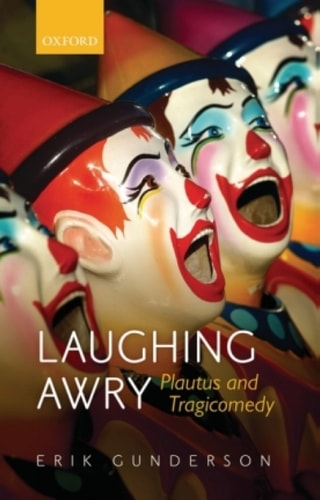
Laughing Awry: Plautus and Tragicomedy
0
0
As an Amazon Associate and affiliate partner, Menrva Books earns from qualifying purchases. Learn more
Author Description
Laughing Awry offers a comprehensive overview of key themes in the interpretation of the plays of Plautus, and explores the connections between deception, desire, slavery, genre, and audience. In doing so, it offers an account of the mechanisms of Plautus' humour and the uncomfortable origins of laughter, revealing how his dramas do not just play to but also work on the audience. The volume examines the whole corpus of Plautine plays, providing longer accounts of selected dramas and choice scenes. An emphasis on methodological and theoretical questions is maintained throughout, and particular attention is paid to the psychic life of humour and its relationship to questions of social power. Chapters discuss, among other topics, the problem of writing about humour, Plautus' reception by subsequent Roman authors, the plays' embedded social theory, the intersection of circuits of desire, laughter as a scandalous surfeit, and the sublime perversity of laughter. The volume asks what we are laughing at, why we laugh, and what this laughter means.
Menrva's Summary
THE THESIS
This volume investigates the mechanisms of Plautine humor and the underlying social and psychological functions of laughter within the context of Roman comedy. Erik Gunderson, a scholar of classical literature and cultural theory, utilizes a framework that integrates psychoanalytic theory with historical analysis to examine how Plautus’ plays manipulate audience response. The work argues that laughter in these dramas serves as a complex site of social power, desire, and subversion rather than mere entertainment.
THE SCOPE MAP
What You Will Find
- Comprehensive analysis of the entire corpus of Plautine plays.
- Theoretical exploration of the psychic life of humor and its relationship to social power.
- Examination of the intersection between deception, slavery, and genre conventions.
- Discussion of Plautus' reception by later Roman authors.
Scope Limits
- The text focuses primarily on theoretical and methodological interpretations rather than providing a purely historical or biographical account of the playwright.
THE AUTHORITY PERSPECTIVE
Scholars and students of classical drama frequently note the theoretical density and interdisciplinary approach of the prose. Experts highlight this text as a significant contribution to understanding the darker, more subversive elements of Roman comedy beyond traditional interpretations.
Page Count:
320
Publication Date:
2015-01-01
Publisher:
OUP Oxford
ISBN-10:
0191045543
ISBN-13:
9780191045547
History
Drama
Criticism history
Humor Theory
Roman History
Literary Criticism
Ancient History
Community Tags
Similar Books