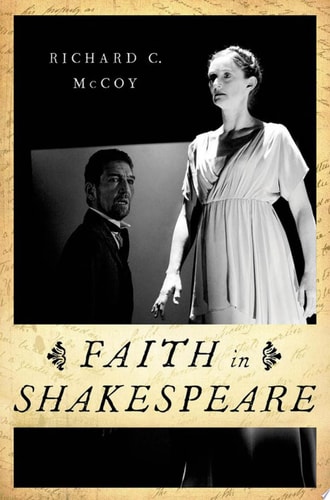
Faith in Shakespeare
0
0
As an Amazon Associate and affiliate partner, Menrva Books earns from qualifying purchases. Learn more
Author Description
Speculation about Shakespeare's own religious beliefs and responses to the Reformation have dominated discussions of faith in the playwright's work for decades. As a result, we often lose sight of what's truly important-the plays themselves. By focusing on those plays in several succinct, fluently written chapters, Richard McCoy reminds us of the spell-binding power inherent in works like Othello, As You Like It, and The Winter's Tale and shows why they continue to cause audiences to gladly exercise what Samuel Taylor Coleridge called the "willing suspension of disbelief."Faith in Shakespeare ruminates on what it means to believe in the Bard's plays, exploring how their plots can be both preposterous and gripping, and how their characters seem more substantial and enduring than the people surrounding us in the theater. Informed by Coleridge's "poetic faith," the book discusses what this concept shares with religious faith and how it departs from recent historicist approaches to the dramatist's work. Faith in Shakespeare concentrates more on text than context, finding the afterlife of Shakespeare's language more vivid and engaging than theological controversies. The book confirms its convictions in literature's intrinsic powers by exploring the causes for our paradoxical belief in theater's potent but manifest illusions. Plays that ask their audience to "awake your faith" or "believe then, if you please" ultimately enable us to "mind true things by what their mockeries be." Rather than faith in God or the supernatural, McCoy argues that faith in Shakespeare is sustained and explained only by the complex, subtle, and entirely human power of poetic eloquence and dramatic performance.
Menrva's Summary
THE THESIS
This book investigates the nature of audience engagement with Shakespearean drama, specifically questioning how the concept of 'poetic faith' functions as a substitute for religious belief. Richard C. McCoy, a scholar of early modern literature, utilizes a close-reading approach to analyze how Shakespeare’s language and dramatic structures compel audiences to accept manifest illusions as truth. The author argues that the enduring power of these plays resides in their linguistic eloquence and performance rather than in theological or historical context.
THE SCOPE MAP
What You Will Find
- Analysis of specific plays including Othello, As You Like It, and The Winter's Tale
- Application of Samuel Taylor Coleridge's concept of 'poetic faith'
- Critique of recent historicist approaches to Shakespearean scholarship
- Examination of the relationship between theatrical illusion and human belief
Scope Limits
- The text does not provide a historical biography of Shakespeare's personal religious affiliations
- It avoids deep dives into the theological controversies of the Reformation era
THE AUTHORITY PERSPECTIVE
Scholars and readers frequently note the book's focus on textual analysis over historical context, positioning it as a counter-argument to traditional historicist readings. Experts highlight this as a concise and accessible exploration of the aesthetic mechanics that sustain the audience's belief in dramatic performance.
Page Count:
214
Publication Date:
2015-02-01
Publisher:
Oxford University Press
ISBN-10:
0190218657
ISBN-13:
9780190218652
Philosophy
Drama
Literary Criticism
Poetics
Romanticism
Community Tags
Similar Books