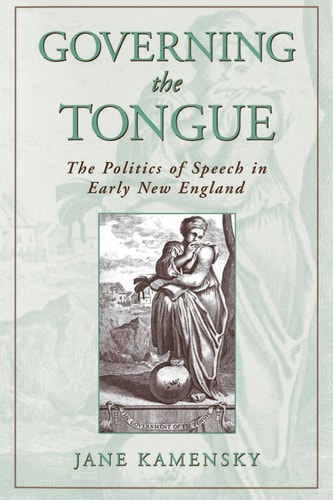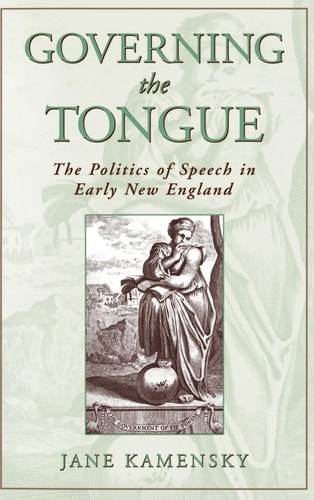
Governing the Tongue: The Politics of Speech in Early New England
0
0
As an Amazon Associate and affiliate partner, Menrva Books earns from qualifying purchases. Learn more
Author Description
Governing the Tongue explains why the spoken word assumed such importance in the culture of early New England. In a work that is at once historical, socio-cultural, and linguistic, Jane Kamensky explores the little-known words of unsung individuals, and reconsiders such famous Puritan events as the banishment of Anne Hutchinson and the Salem witch trials, to expose the ever-present fear of what the Puritans called "sins of the tongue." But even while dangerous or deviant speech was restricted, as Kamensky illustrates here, godly speech was continuously praised and promoted. Congregations were told that one should lift one's voice "like a trumpet" to God and "cry out and cease not." By placing speech at the heart of New England's early history, Kamensky develops new ideas about the complex relationship between speech and power in both Puritan New England and, by extension, our world today.
Menrva's Summary
THE THESIS
How did the regulation of speech function as a primary mechanism of social and political control in early New England? Jane Kamensky, a historian specializing in early American culture, utilizes a synthesis of legal records, personal diaries, and theological tracts to argue that the spoken word was a central site of power. She posits that the Puritan obsession with 'sins of the tongue' served to define communal boundaries and reinforce hierarchical structures within the fledgling colonies.
THE SCOPE MAP
What You Will Find
- Analysis of legal proceedings regarding slander, blasphemy, and gossip in colonial courts.
- Examination of the theological mandate for 'godly speech' as a public performance.
- Case studies of high-profile historical figures including Anne Hutchinson and the Salem witch trial participants.
- A framework connecting linguistic behavior to the broader socio-political power dynamics of the seventeenth century.
THE AUTHORITY PERSPECTIVE
Historians frequently cite this work as a foundational study for understanding the intersection of language and authority in colonial America. Experts highlight the author's ability to bridge the gap between micro-historical analysis of individual speech acts and the macro-historical trends of Puritan governance.
Page Count:
304
Publication Date:
1998-01-08
Publisher:
Oxford University Press
ISBN-10:
0195090802
ISBN-13:
9780195090802
History
Political Aspects
American History
Puritanism
Language And Culture
Americanisms
Puritans
Sociology
Linguistics
Colonial History