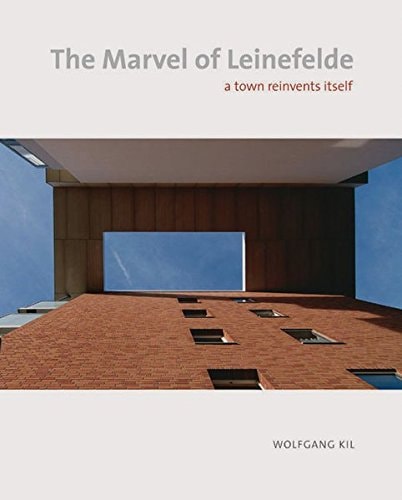
The Marvel of Leinefelde: A Town Reinvents Itself
0
0
As an Amazon Associate and affiliate partner, Menrva Books earns from qualifying purchases. Learn more
Author Description
Whoever wrestles with the intractable difficulties of empty housing in East Germany can look at Leinefelde and rest easier. Here, demolition was never the last word. The message that comes out of this place is anything but discouraging: and it is nothing to do with growth! Positive town development is no longer tied to more settlement areas, or increasing populations and expanding commerce. It has often been claimed that "there are real chances with the process of becoming less" - finally there is proof that these are more than just words of comfort. Leinefelde has reduced and reconfigured its Sudstadt as if in a big laboratory experiment, and in doing so, has demonstrated that the consequences of inevitable shrinkage can be contained by determined action and offset wherever possible with other qualities. The aim of this book is to describe this experiment, to consider the conditions behind its success and to ask whether what has been done here could be generalized and applied elsewhere.
Menrva's Summary
THE THESIS
Leinefelde, a town in East Germany, serves as a unique case study for managing urban shrinkage and reinventing itself without population growth. The book details how Leinefelde transformed its Sudstadt district, demonstrating that positive town development is possible even with decreasing populations and commerce. It explores the conditions that led to this success and questions whether these strategies can be replicated in other shrinking regions, offering a counter-narrative to purely growth-oriented development models.
THE SCOPE MAP
- Analysis of urban shrinkage challenges in East Germany.
- Detailed examination of Leinefelde's Sudstadt reconfiguration.
- Exploration of strategies for positive town development without growth.
- Case study of successful urban transformation.
- Discussion of the conditions enabling Leinefelde's success.
- Consideration of the generalizability of Leinefelde's model.
- Insights into managing inevitable shrinkage through determined action.
THE AUTHORITY PERSPECTIVE
The book presents Leinefelde as a crucial example for understanding and managing urban decline, particularly in post-reunification East Germany. It highlights the town's innovative approach to shrinking its urban footprint, suggesting that a reduction in population and commercial activity does not necessarily equate to negative development. The work aims to provide empirical evidence that 'becoming less' can be a viable strategy for urban renewal, offering lessons applicable to other regions facing similar demographic and economic challenges.
Page Count:
164
Publication Date:
2008-01-01
Publisher:
Sandstein
ISBN-10:
3940319384
ISBN-13:
9783940319388
History
Economics
Non-Fiction
German Studies
urban planning
Sociology
Case Study
Community Tags
Similar Books