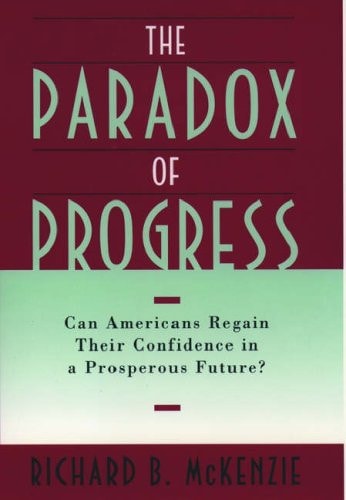
The Paradox of Progress: Can Americans Regain Their Confidence in a Prosperous Future?
0
0
As an Amazon Associate and affiliate partner, Menrva Books earns from qualifying purchases. Learn more
Author Description
Things have never been better--and tomorrow they'll be better still. So argues Richard B. McKenzie in this provocative new book, The Paradox of Progress. Despite all the press stories of lay-offs and stagnant wages, despite all the talk of economic insecurity, says McKenzie, Americans have never lived so well, or had so many opportunities. The question, he writes, is not why things aren't better, but why does everyone keep complaining.In The Paradox of Progress, McKenzie demolishes the idea that the nation is in economic decline--and explains why we still feel so insecure. Writing with tremendous passion and insight, he marshals an array of data to show that the American standard of living has never been higher in real terms. Our perception of decline, he argues, comes from the press, which has long since learned that bad news sells; but he demonstrates how the 1980s--much-maligned by the media--in fact heralded a new age of prosperity and opportunity. The corporate downsizing of recent years signals the change: the old monolithic firms of the past are adjusting to an era of smaller companies, mobile capital, and new entrepreneurship. A new economic frontier is opening up--the "New West," as he calls it--as the rapid growth of electronic technology creates fresh room for growth and creativity. Government needs to get out of the way and accept the shift in "economic tectonics." And the message for workers, McKenzie writes, is clear: "Become more productive. Work harder and smarter. Get more education and skills. Get competitive. Do more than others have been doing or will likely do. Stop complaining."Public anxiety is justified, McKenzie adds, but it is misplaced: for if the shift in "economic tectonics" is ultimately a positive development, it has been accompanied by a "moral tectonics" earthquake that has been highly destructive. McKenzie attacks this moral earthquake head on, passionately echoing the words of Nobel Laureate F. A. Hayek, arguing that it is essentia
Menrva's Summary
THE THESIS
Can the American public reconcile the objective reality of economic prosperity with the subjective feeling of widespread insecurity? Richard B. McKenzie, an economist and professor, investigates the disconnect between rising standards of living and the pervasive narrative of national decline. By analyzing economic data from the late 20th century, he argues that the structural shift toward smaller, more agile firms and technological advancement represents a positive evolution rather than a crisis, suggesting that public anxiety is misplaced and stems from a misunderstanding of modern economic tectonics.
THE SCOPE MAP
What You Will Find
- Analysis of economic indicators regarding real standards of living and wage growth.
- Examination of corporate downsizing and the transition to a mobile, entrepreneurial economy.
- Critique of media influence on public perception of economic health.
- Discussion of the moral and cultural shifts accompanying technological and industrial change.
THE AUTHORITY PERSPECTIVE
Critics and readers often note the author's provocative, contrarian stance on 1980s economic policy and media reporting. The text is frequently cited for its focus on the intersection of economic data and public psychology, serving as a point of debate for those interested in the evolution of the American labor market.
Page Count:
256
Publication Date:
1997-03-06
Publisher:
Oxford University Press
ISBN-10:
0195102398
ISBN-13:
9780195102390
Business
Economics
Public Policy
American History
Sociology
Progress
Community Tags
Similar Books