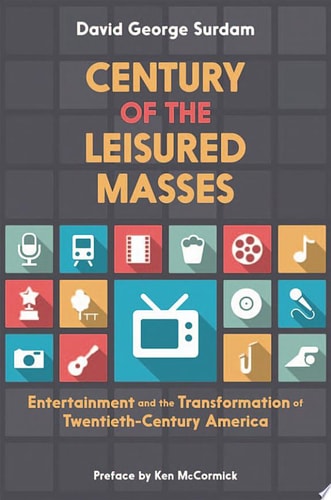
Century of the Leisured Masses: Entertainment and the Transformation of Twentieth-Century America
0
0
As an Amazon Associate and affiliate partner, Menrva Books earns from qualifying purchases. Learn more
Author Description
American living standards improved considerably between 1900 and 2000. While most observers focus on gains in per-capita income as a measure of economic well-being, economists have used other measures of well-being: height, weight, and longevity. The increased amount of leisure time per week and across people's lifetimes, however, has been an unsung aspect of the improved standard of living in America. In Century of the Leisured Masses, David George Surdam explores the growing presence of leisure activities in Americans' lives and how this development came out throughout the twentieth century. Most Americans have gone from working fifty-five or more hours per week to working fewer than forty, although many Americans at the top rungs of the economic ladder continue to work long hours. Not only do more Americans have more time to devote to other activities, they are able to enjoy higher-quality leisure. New forms of leisure have given Americans more choices, better quality, and greater convenience. For instance, in addition to producing music themselves, they can now listen to the most talented musicians when and where they want. Television began as black and white on small screens; within fifty years, Americans had a cast of dozens of channels to choose from. They could also purchase favorite shows and movies to watch at their convenience. Even Americans with low incomes enjoyed television and other new forms of leisure. This growth of leisure resulted from a combination of growing productivity, better health, and technology. American workers became more productive and chose to spend their improved productivity and higher wages by consuming more, taking more time off, and enjoying better working conditions. By century's end, relatively few Americans were engaged in arduous, dangerous, and stultifying occupations. The reign of tyranny on the shop floor, in retail shops, and in offices was mitigated; many Americans could even enjoy leisure activities during work hours.
Menrva's Summary
THE THESIS
This book investigates how the expansion of leisure time and the evolution of entertainment activities served as a primary indicator of improved living standards for Americans throughout the twentieth century. David George Surdam, an economist, utilizes historical economic data and social trends to argue that the transition from long, arduous work weeks to increased personal time represents a significant, often overlooked, shift in American economic well-being. He examines how productivity gains, technological advancements, and improved health outcomes allowed the average citizen to access higher-quality entertainment and more flexible schedules.
THE SCOPE MAP
What You Will Find
- Analysis of the transition from 55-hour work weeks to sub-40-hour standards.
- Examination of the impact of technological shifts on leisure, including the evolution of music consumption and television.
- Discussion of the relationship between rising productivity, higher wages, and the demand for recreational time.
Scope Limits
- The text focuses primarily on the general American population and does not provide an exhaustive analysis of the leisure habits of the extreme economic elite.
- The book does not cover the psychological or sociological implications of leisure beyond its role as an economic metric.
THE AUTHORITY PERSPECTIVE
Experts recognize this work as a valuable economic history that bridges the gap between labor statistics and cultural consumption patterns. Readers frequently note the accessible prose style, which makes complex economic trends understandable for those outside the field of professional economics.
Page Count:
448
Publication Date:
2014-01-01
Publisher:
Oxford University Press, Incorporated
ISBN-10:
019021158X
ISBN-13:
9780190211585
Economics
History
Leisure Class
United States
Labor Studies
Social Science
Leisure
Cultural History
American History
Community Tags
Other Editions(2)
Similar Books







Reader Comments
Share Your Thoughts
No comments yet. Be the first to share your thoughts!