
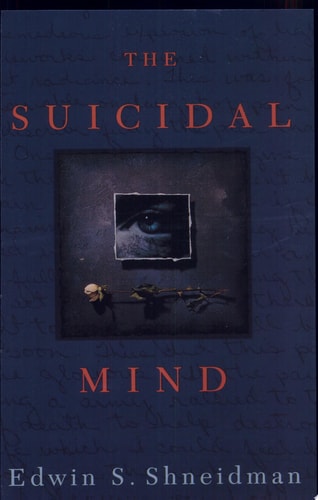
The Suicidal Mind
0
0
As an Amazon Associate and affiliate partner, Menrva Books earns from qualifying purchases. Learn more
Author Description
Suicide haunts our literature and our culture, claiming the lives of ordinary people and celebrities alike. It is now the third leading cause of death for fifteen- to twenty-four-year-olds in the United States, raising alarms across the nation about the rising tide of hopelessness seen in our young people. It is a taboo subtext to our successes and our happiness, a dark issue that is often euphemized, avoided, and little understood. In our century, psychology and psychiatry alike have attempted to understand, prevent, and medicalize these phenomena. But they have failed, argues Dr. Edwin Shneidman, because they have lost sight of the plain language, the ordinary everyday words, the pain and frustrated psychological needs of the suicidal individual.In The Suicidal Mind, Dr. Shneidman has written a work for every person who has ever thought about suicide or knows anybody who has contemplated it. The book brims with insight into the suicidal impulse and with helpful suggestions on how to counteract it. Shneidman presents a bold and simple premise: the main cause of suicide is psychological pain or "psychache." Thus the key to preventing suicide is not so much the study of the structure of the brain, or the study of social statistics, or the study of mental diseases, as it is the direct study of human emotions. To treat a suicidal individual, we need to identify, address, and reduce the individual's psychache. Shneidman shares with the reader his knowledge, both as a clinician and researcher, of the psychological drama that plays itself out in the suicidal mind through the exploration of three moving case studies. We meet Ariel, who set herself on fire; Beatrice, who cut herself with the intent to die; and Castro, a young man who meant to shoot his brains out but survived, horribly disfigured. These cases are presented in the person's own words to reveal the details of the suicidal drama, to show that the purpose of suicide is to seek a solution.
Menrva's Summary
THE THESIS
The central question investigated is whether the primary driver of suicide is an unbearable state of psychological pain, or 'psychache,' rather than purely biological or sociological factors. Dr. Edwin S. Shneidman, a pioneer in the field of suicidology, argues that clinical approaches have historically failed by prioritizing medicalization over the subjective experience of the individual. He proposes a framework that centers on identifying and reducing the specific emotional anguish of the patient to prevent self-harm. By shifting the focus from statistical data to the internal psychological drama, the author provides a clinical methodology for understanding the suicidal impulse.
THE SCOPE MAP
What You Will Find
- A comprehensive definition and exploration of the concept of 'psychache' as the primary motivator for suicide.
- Detailed clinical case studies of three individuals, including their personal narratives and motivations.
- A critical evaluation of traditional psychiatric and psychological approaches to suicide prevention.
- Practical methodologies for clinicians and laypeople to identify and address the psychological needs of those at risk.
THE AUTHORITY PERSPECTIVE
Experts in the field of mental health recognize this work as a foundational text that shifted the clinical focus toward the patient's subjective emotional state. Readers frequently note the accessibility of the prose despite the heavy subject matter, highlighting the author's compassionate and direct approach to a complex psychological phenomenon.
Page Count:
208
Publication Date:
1996-05-23
Publisher:
Oxford University Press
ISBN-10:
0195103661
ISBN-13:
9780195103663
Politics
Non-Fiction
Psychology
Counseling Psychology
Pathologies
Mental Health
Bible Study
Mental Illness
Suicidology
Suicide
Community Tags
Other Editions(2)
Similar Books















Reader Comments
Share Your Thoughts
No comments yet. Be the first to share your thoughts!