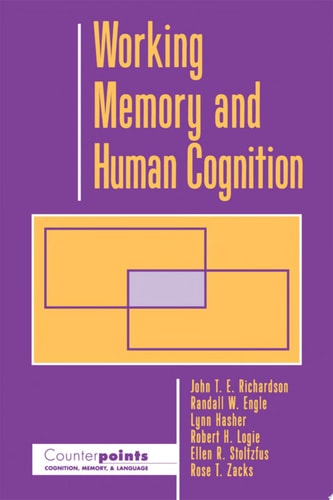
Working Memory and Human Cognition (Counterpoints: Cognition, Memory, and Language)
0
0
As an Amazon Associate and affiliate partner, Menrva Books earns from qualifying purchases. Learn more
Author Description
This new volume in the Counterpoints series compares and contrasts different conceptions of working memory, generally recognized as the mechanism within the human cognitive system that is responsible for the temporary storage and processing of information. This notion has been used in a wide variety of ways, partly because it encapsulates several themes that have appeared in the history of research into human memory and cognition. Consequently, variations in the usage of the term working memory also arise because it is invoked by theorists with different research agendas and perspectives. The book includes contributions from proponents of different views: Robert Logie discusses the existence of three different components that control temporary verbal storage, temporary visuo-spatial storage, and the central coordination of both processing and storage, including the retrieval of information from long-term memory. Ellen Stoltzfus, Lynn Hasher, and Rose Zacks focus on the inhibitory processes that control the entrance of information into working memory and update the contents by deleting information that is no longer relevant to the task at hand. Randall Engle argues that individual differences in working memory are tantamount to differences in the attentional resources needed to retrieve information from memory, and that these lead to differences in the ability to inhibit or suppress irrelevant information. Finally, editor John Richardson identifies the key issues that have divided researchers in this field and gives an integrated account of what has been discovered about working memory. As interest in working memory is increasing at a rapid pace, an open discussion of the central issues involved is both useful and timely. This work serves this purpose for cognitive psychologists and their students.
Menrva's Summary
THE THESIS
This volume investigates the divergent theoretical frameworks and definitions surrounding the concept of working memory within the human cognitive system. The text compiles contributions from prominent researchers who examine how working memory functions as a mechanism for temporary storage and information processing. By contrasting various models—ranging from inhibitory control to attentional resource allocation—the authors provide a comprehensive overview of the mechanisms that govern how humans manage and update relevant information.
THE SCOPE MAP
What You Will Find
- Analysis of the three-component model of working memory involving verbal and visuo-spatial storage.
- Examination of inhibitory processes responsible for filtering and deleting irrelevant information.
- Discussion of individual differences in attentional resources and their impact on memory retrieval.
- Integrated synthesis of the primary debates and historical research agendas in cognitive psychology.
THE AUTHORITY PERSPECTIVE
Experts identify this work as a foundational text for students and professionals in cognitive psychology seeking to understand the competing models of memory. Readers frequently note the academic density of the prose, which effectively captures the nuanced debates currently shaping the field.
Page Count:
176
Publication Date:
1996-05-16
Publisher:
Oxford University Press
ISBN-10:
0195101006
ISBN-13:
9780195101003
Psychology
Cognition
Counseling Psychology
Kindle Store
Categories
Kindle eBooks
Memory
Neuroscience
Academic
Cognitive
Community Tags
Similar Books








Reader Comments
Share Your Thoughts
No comments yet. Be the first to share your thoughts!