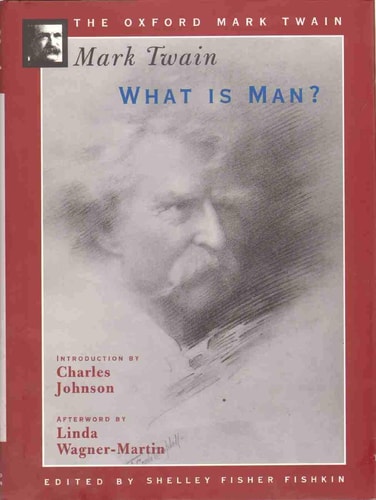
What Is Man?
0
0
As an Amazon Associate and affiliate partner, Menrva Books earns from qualifying purchases. Learn more
Author Description
What Is Man? is Mark Twain's skeptical assessment of free will, and determinism, religious belief, and the nature of humanity. He put off publishing it for 25 years, and then released it anonymously in a limited edition of 250 copies. The book takes the form of a Socratic dialogue between a romantic young idealist and an elderly cynic, who debate such issues as whether man is a machine or a free actor, whether personal merit is meaningless given how our environment shapes who we are, and whether man has any impulse other than pursuing pleasure and avoiding pain. As readers "we listen attentively, leaning forward in our chairs," Charles Johnson writes in his introduction, weighing on our own such statements as the Old Man's claim that "No man ever originates anything.... Men observe and combine, that is all. So does a rat." Linda Wagner-Martin, in the afterword, sees the ideas expressed in this volume as "a thread that runs through even the lightest of Mark Twain's fiction, the calmest of his memoirs; and as the questioning hook that may provide a rationale for his becoming a writer in the first place."
Menrva's Summary
THE THESIS
This work investigates the fundamental nature of human agency, questioning whether free will exists or if human behavior is entirely determined by external forces and biological conditioning. Mark Twain, writing from the perspective of a seasoned observer of human folly, utilizes a philosophical framework to challenge conventional notions of morality and individual merit. By examining the interplay between environment and impulse, the text argues that human actions are largely mechanical responses to external stimuli rather than products of independent choice.
THE SCOPE MAP
What You Will Find
- A Socratic dialogue format featuring an idealist and a cynic.
- Philosophical arguments regarding determinism versus free will.
- Analysis of the human impulse to pursue pleasure and avoid pain.
- Critical examination of the origins of human thought and creativity.
THE AUTHORITY PERSPECTIVE
Scholars and critics identify this text as a crucial window into the darker, more cynical philosophical underpinnings of Twain's later career. Readers frequently note that the dialogue format provides a structured, albeit dense, exploration of ideas that appear in more subtle forms throughout his broader literary body of work.
Page Count:
224
Publication Date:
1996-12-05
Publisher:
Oxford University Press
ISBN-10:
0195101545
ISBN-13:
9780195101546
Philosophy
Non-Fiction
Essays
Human beings
Social Commentary
Humanism
Mind & Body
Community Tags
Other Editions(15)
Dover Publications
2019
Default edition
Independently Published
2019

CreateSpace Independent Publishing Platform
2017
CreateSpace Independent Publishing Platform
2015
Fpp Classics
2015

CreateSpace Independent Publishing Platform
2014
Jazzybee Verlag
2014
Bod Third Party Titles
2013
BoD – Books on Demand
2012
BoD – Books on Demand
2010
Book Tree
2007
IndyPublish.com
2007
Blue Unicorn Edition, LLC
2000

Oxford University Press
1997
Oxford University Press
1996
Similar Books


Reader Comments
Share Your Thoughts
No comments yet. Be the first to share your thoughts!