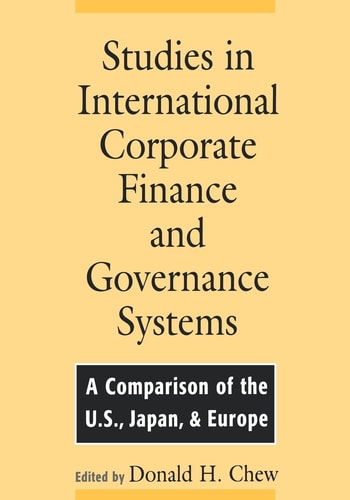
Studies in International Corporate Finance and Governance Systems: A Comparison of the U.S., Japan, and Europe
0
0
As an Amazon Associate and affiliate partner, Menrva Books earns from qualifying purchases. Learn more
Author Description
The past decade has given rise to a growing debate over the relative efficiency of different national economic systems. There are two basic corporate finance and governance systems that predominate in today's developed economies. One is the Anglo-American market based model, with widely dispersed shareholders and a fairly vigorous corporate control market. The other is the Japanese and German relationship based system, with its large bank and intercorporate holdings (and conspicuous absence of takeovers). Given the increasing globalization of business, which of these two systems can be expected to prevail over time? Or will the most valuable aspects of each be blended into a single new system? The story now being told by economists and management experts -- one that this book presents -- is a complicated one. Here is a sampling of the arguments:Corporate strategist Michael Porter states that the U.S. system of allocating capital both within and across companies appears to be failing because of both capital market and internal pressures on U.S. companies to underinvest in the relatively intangible assets that contribute to corporate capabilities. In contrast to Porter, financial economist Michael Jensen maintains that the most formidable challenge now facing the U.S. economy -- and, indeed, the economies of all industrialized nations -- is the corporate overinvestment problem, a problem that was addressed in the U.S. by the leveraged restructuring of the 1980s. Nobel-Prize economist Merton Miller answers both Porters concern about U.S. underinvestment and Jensens pessimism about U.S. control systems with a classic defense of the shareholder-value principle. Corporate strategist C.K. Prahalad, unconvinced by the arguments of both Miller and Jensen, challenges the wisdom of corporate Americas commitment to maximizing shareholder value. In a roundtable discussion, Prahalad debates with shareholder value advocate Bennett Stewart about the effects of shareholder primacy i
Menrva's Summary
THE THESIS
This book investigates which corporate finance and governance model—the Anglo-American market-based system or the Japanese and German relationship-based system—is better suited to prevail in an increasingly globalized economy. Donald Chew compiles a series of expert analyses to examine the efficiency and long-term viability of these competing economic structures. By presenting conflicting viewpoints from prominent economists and strategists, the text explores whether these systems will remain distinct or eventually converge into a hybrid model.
THE SCOPE MAP
What You Will Find
- Comparative analysis of Anglo-American market-based models versus Japanese and German relationship-based systems.
- Examination of capital allocation strategies and corporate control mechanisms.
- Debates regarding shareholder value maximization versus long-term intangible asset investment.
- Perspectives from leading economic thinkers including Michael Porter, Michael Jensen, and Merton Miller.
THE AUTHORITY PERSPECTIVE
Experts recognize this collection as a significant resource for understanding the structural tensions within global corporate governance during the late 20th century. Readers frequently note the academic density of the prose, which provides a rigorous foundation for those studying the evolution of international economic systems.
Page Count:
384
Publication Date:
1997-01-16
Publisher:
Oxford University Press
ISBN-10:
0195107950
ISBN-13:
9780195107951
Economics
Corporations japan
Corporate governance
International business
Corporations
Management
Finance
Community Tags
Similar Books











Reader Comments
Share Your Thoughts
No comments yet. Be the first to share your thoughts!