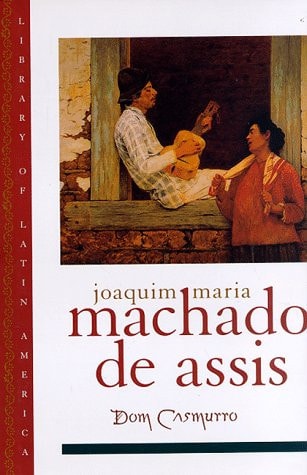
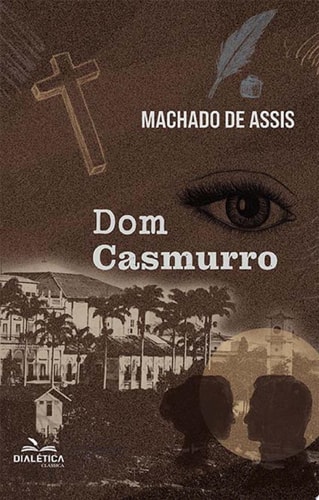
Dom Casmurro
0
0
As an Amazon Associate and affiliate partner, Menrva Books earns from qualifying purchases. Learn more
Author Description
"A palm tree, seeing me troubled and divining the cause, murmured in its branches that there was nothing wrong with fifteen-year old boys getting into corners with girls of fourteen; quite the contrary, youths of that age have no other function, and corners were made for that very purpose. It was an old palm-tree, and I believed in old palm-trees even more than in old books. Birds, butterflies, a cricket trying out its summer song, all the living things of the air were of the same opinion." So begins this extraordinary love story between Bento and Capitu, childhood sweethearts who grow up next door to each other in Rio de Janeiro in the 1850s.Like other great nineteenth century novels--The Scarlet Letter, Anna Karenina, Madame Bovary--Machado de Assis's Dom Casmurro explores the themes of marriage and adultery. But what distinguishes Machado's novel from the realism of its contemporaries, and what makes it such a delightful discovery for English-speaking readers, is its eccentric and wildly unpredictable narrative style. Far from creating the illusion of an orderly fictional "reality," Dom Casmurro is told by a narrator who is disruptively self-conscious, deeply subjective, and prone to all manner of marvelous digression. As he recounts the events of his life from the vantage of a lonely old age, Bento continually interrupts his story to reflect on the writing of it: he examines the aptness of an image or analogy, considers cutting out certain scenes before taking the manuscript to the printer, and engages in a running, and often hilarious, dialogue with the reader. "If all this seems a little emphatic, irritating reader," he says, "it's because you have never combed a girl's hair, you've never put your adolescent hands on the young head of a nymph..." But the novel is more than a performance of stylistic acrobatics. It is an ironic critique of Catholicism, in which God appears as a kind of divine accountant whose ledgers may be balanced in devious as well as pious
Menrva's Summary
THE PULSE
Bento Santiago, an aging recluse, attempts to reconstruct the history of his marriage to Capitu to determine if his suspicions of infidelity are grounded in reality. Bento seeks to justify his lifelong jealousy and isolation by narrating his past, yet he faces the persistent obstacle of his own unreliable memory and subjective perspective. The narrative unfolds as a non-linear, first-person account, where the protagonist struggles against the ambiguity of his own life choices and the elusive nature of truth. The world of 19th-century Rio de Janeiro serves as a rigid social backdrop, contrasting sharply with the fluid, often chaotic internal state of the narrator.
INSIDE THE PAGES
- Unreliable first-person narration that questions the validity of memory
- Meta-fictional commentary where the narrator addresses the reader directly
- Frequent digressions that interrupt the chronological flow of the plot
- Exploration of jealousy and the psychological toll of suspicion
- Satirical critique of 19th-century social norms and religious institutions
- Intimate focus on the development of childhood sweethearts into adults
- Use of irony to undermine the narrator's own claims of certainty
- Stylistic playfulness that contrasts with the gravity of the central conflict
THE COLLECTIVE ECHO
Readers and critics frequently highlight the novel's innovative narrative structure, which challenges traditional notions of realism. Discussion often centers on the ambiguity of Capitu's character, as the reader is forced to view her entirely through the lens of a deeply biased and self-conscious narrator. Many appreciate the balance between the intimate domestic drama and the broader ironic commentary on Brazilian society. The work is widely recognized for its psychological depth and the way it forces the audience to participate in the act of interpretation. Scholars often note that the narrator's constant interruptions serve to heighten the tension rather than alleviate it, making the text a complex study of human perception.
Page Count:
288
Publication Date:
1997-11-20
Publisher:
Oxford University Press
ISBN-10:
0195103084
ISBN-13:
9780195103083
Literary Fiction
Romance
classic
Psychological
Historical
Community Tags
Other Editions(7)




Similar Books


Reader Comments
Share Your Thoughts
No comments yet. Be the first to share your thoughts!