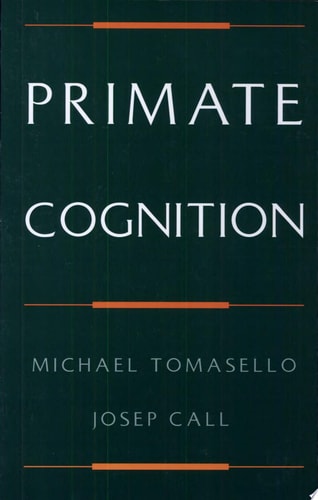
Primate Cognition
0
0
As an Amazon Associate and affiliate partner, Menrva Books earns from qualifying purchases. Learn more
Author Description
Soon after Charles Darwin formulated his theory of evolution, primate cognition became a major area of research. In this book, Michael Tomasello and Josep Call assess the current state of our knowledge about the cognitive skills of non-human primates. They integrate empirical findings on the topic from the beginning of the century to the present, placing this research in theoretical perspective. They begin with an examination of the way primates adapt to their physical world, mostly for the purpose of foraging. The second part of the book looks at primate social knowledge and focuses on the adaptations of primates to their social world for purposes of competition and cooperation. In the third section, the authors construct a general theory of primate cognition, distinguishing the cognition in primates from that of other mammals (human in particular). Their broad-ranging theory provides a guide for future research. Primate Cognition is an enlightening exploration of the cognitive capacities of our nearest primate relatives and a useful resource for a wide range of researchers and students in psychology, behavioral biology, primatology, and anthropology.
Menrva's Summary
THE THESIS
This book investigates the cognitive architecture of non-human primates to determine how their mental capacities evolved in relation to their physical and social environments. Michael Tomasello and Josep Call, both established experts in comparative psychology and primatology, synthesize decades of empirical research to construct a comprehensive framework. They argue that primate cognition is fundamentally shaped by the specific demands of foraging and complex social interactions, distinguishing these processes from those found in other mammalian species.
THE SCOPE MAP
What You Will Find
- Analysis of physical cognition related to foraging and spatial navigation
- Examination of social cognition, including competitive and cooperative behaviors
- Integration of empirical data from the early 20th century to the present
- A theoretical model distinguishing primate cognitive evolution from other mammals
THE AUTHORITY PERSPECTIVE
Experts in the field recognize this work as a foundational text for understanding the cognitive evolution of primates. Researchers and students frequently cite the book for its rigorous synthesis of behavioral data and its clear theoretical structure.
Page Count:
528
Publication Date:
1997-09-18
Publisher:
Oxford University Press
ISBN-10:
0195106245
ISBN-13:
9780195106244
Psychology
Science
Evolutionary Biology
Anthropology
Primates
Biology
Primatology
Community Tags
Other Editions(3)

Similar Books