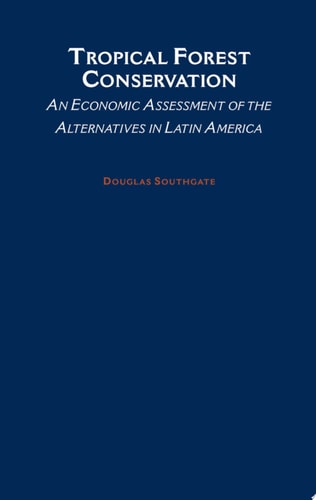
Tropical Forest Conservation: An Economic Assessment of the Alternatives in Latin America
0
0
As an Amazon Associate and affiliate partner, Menrva Books earns from qualifying purchases. Learn more
Author Description
Attempts to halt the destruction of rain forests and other natural habitats in the tropics have met with little success. In particular, national parks, like those found in wealthy nations, have proven difficult to establish in Africa, Asia, and South and Central America. More often than not, people inhabiting areas designated for protection resist being told by outsiders that they must change how and where they live. Alternative approaches, frequently embodied in integrated conservation and development projects (ICDPs), are now being pursued. The goal is to address local communities' desires for improved standards of living while simultaneously meeting conservation objectives. Nature-based tourism and sustainable harvesting of forest products are the centerpieces of ICDPs and related initiatives. This book assesses the viability of conservation strategies predicated on the adoption of environmentally sound enterprises in and around threatened habitats. Drawing on research in Brazil, Costa Rica, Ecuador and Peru and on his extensive experience working in South and Central America and the Caribbean, the author demonstrates that it is rare for forest dwellers to derive much benefit from ecotourism, the extraction of timber and other commodities, or the collection of samples used in pharmaceutical research. Often these activities are simply unprofitable. Even when they are profitable, the benefits tend not to accrue locally, but instead are captured by outside firms and individuals who can provide important services like safe and reliable transportation. The author contends that human capital formation and related productivity-enhancing investment is the only sure path to economic progress and habitat conservation.
Menrva's Summary
THE THESIS
This book investigates whether environmentally sound enterprises, such as ecotourism and sustainable harvesting, can effectively reconcile local economic development with the preservation of tropical forest habitats. Douglas Southgate, an expert with extensive field experience in Latin America and the Caribbean, evaluates the practical outcomes of integrated conservation and development projects. By analyzing economic data from Brazil, Costa Rica, Ecuador, and Peru, he argues that these small-scale initiatives often fail to provide meaningful local benefits. Instead, he posits that long-term habitat protection is more reliably achieved through broad investments in human capital and productivity-enhancing infrastructure.
THE SCOPE MAP
What You Will Find
- Economic assessment of integrated conservation and development projects (ICDPs).
- Comparative analysis of conservation outcomes in Brazil, Costa Rica, Ecuador, and Peru.
- Evaluation of the profitability and local benefit distribution of ecotourism and sustainable commodity extraction.
- Argument for prioritizing human capital formation over niche environmental enterprises.
THE AUTHORITY PERSPECTIVE
Experts recognize this work as a critical, evidence-based critique of popular conservation models that rely on local enterprise. Readers frequently note the author's pragmatic approach to the economic realities of rural development in the tropics.
Page Count:
192
Publication Date:
1998-06-04
Publisher:
Oxford University Press
ISBN-10:
0195109961
ISBN-13:
9780195109962
Economics
ForestryWildlifeFisheries
Latin America
Ecotourism
Forest conservation
Trades & Technology
Deforestation
Forestry General
Forest ecology
Conservation
Community Tags
Similar Books