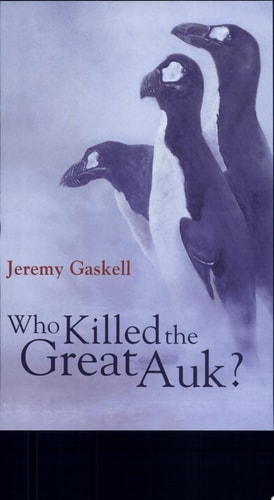
Who Killed the Great Auk?
0
0
As an Amazon Associate and affiliate partner, Menrva Books earns from qualifying purchases. Learn more
Author Description
Part scientific mystery, part cultural history, part intellectual archaeology, Who Killed the Great Auk? vividly tells the story of the extinction that helped launch the first conservation movement.The Great Auk was a large, flightless bird with tiny wings and an enormous beak. Its clumsy, erect gait on land made it an easy target for sailors and landsmen alike, who hunted it for its ample flesh and soft down, and eagerly gathered its eggs. Over time, the Great Auk began to appear less frequently; then rarely; then never again. By the end of the nineteenth century, even the most intrepid explorers could no longer find this once-common bird. Gaskell shows how the Great Auk's disappearance became a cause celebre. It sparked a frenzy among collectors, fascinated writers such as Charles Kingsley, and obsessed such influential ornithologists as John Wolley and John James Audubon, who helped push for the first legislation to protect seabirds. But as Gaskell shows, the extinction of the Great Auk was not a straightforward tale of overhunting. In this subtle, nuanced book, he reveals the ways in which its fate was inextricably bound up with the social, economic, and political history of the time.Who Killed the Great Auk? is nature writing at its best. From the journey of Audubon to Labrador to the hardships of life in early Newfoundland, it takes readers on a tour of some of the wildest and coldest places on earth. And at the end of the story, we understand a little more clearly how we came to value even the oddest inhabitants of the natural world.
Menrva's Summary
THE THESIS
This book investigates the complex socio-economic and environmental factors that led to the extinction of the Great Auk, a flightless seabird that became a focal point for early conservation efforts. Jeremy Gaskell, an expert in natural history, synthesizes historical records, ornithological accounts, and cultural artifacts to argue that the bird's demise was not merely a result of overhunting, but a consequence of shifting human values and industrial pressures. He examines the intersection of nineteenth-century exploration, the rise of scientific collecting, and the emergence of the first legislative protections for wildlife.
THE SCOPE MAP
What You Will Find
- Historical analysis of the nineteenth-century conservation movement and early environmental legislation.
- Examination of the cultural impact of the Great Auk on writers, collectors, and naturalists like John James Audubon.
- Detailed accounts of the economic drivers behind the hunting of seabirds in Newfoundland and Labrador.
- A multidisciplinary study combining biological data with political and social history.
THE AUTHORITY PERSPECTIVE
Experts and readers alike note that Gaskell provides a meticulously researched account that elevates the subject beyond a simple tragedy. The text is frequently cited for its ability to bridge the gap between academic ornithological history and accessible narrative non-fiction.
Page Count:
224
Publication Date:
2001-03-15
Publisher:
Oxford University Press
ISBN-10:
0198564783
ISBN-13:
9780198564782
Science
History
Nature
Conservation
Extinct Birds
Ornithology
Environmental History
Community Tags
Similar Books