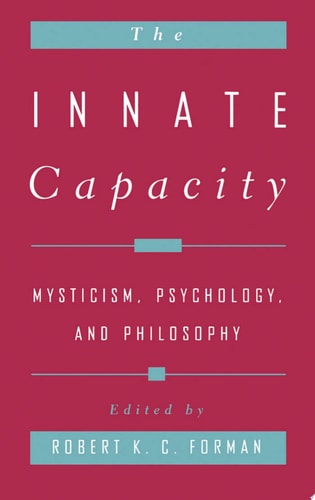
The Innate Capacity: Mysticism, Psychology, and Philosophy
0
0
As an Amazon Associate and affiliate partner, Menrva Books earns from qualifying purchases. Learn more
Author Description
This book is the sequel to Robert Forman's well-received collection, The Problem of Pure Consciousness (Oxford, 1990). The essays in the earlier volume argued that some mystical experiences do not seem to be formed or shaped by the language system--a thesis that stands in sharp contradistinction to deconstruction in general and to the "constructivist" school of mysticism in particular, which holds that all mysticism is the product of a cultural and linguistic process. In The Innate Capacity, Forman and his colleagues put forward a hypothesis about the formative causes of these "pure consciousness" experiences. All of the contributors agree that mysticism is the result of an innate human capacity, rather than a learned, socially conditioned and constructive process.The innate capacity is understood in several different ways. Many perceive it as an expression of human consciousness per se, awareness itself. Some hold that consciousness should be understood as a built-in link to some hidden, transcendent aspect of the world, and that a mystical experience is the experience of that inherent connectedness. Another thesis that appears frequently is that mystics realize this innate capacity through a process of releasing the hold of the ego and the conceptual system. The contributors here look at mystical experience as it is manifested in a variety of religious and cultural settings, including Hindu Yoga, Buddhism, Sufism, and medieval Christianity. Taken together, the essays constitute an important contribution to the ongoing debate about the nature of human consciousness and mystical experience and its relation to the social and cultural contexts in which it appears.
Menrva's Summary
THE THESIS
This volume investigates whether mystical experiences are the product of cultural conditioning or the result of an innate human capacity for pure consciousness. Robert K. C. Forman, a scholar of mysticism and consciousness, assembles a collection of essays that challenge the constructivist view that all religious experience is linguistically and socially determined. The contributors argue that certain states of awareness exist independently of cultural frameworks, proposing that these experiences represent a fundamental, built-in aspect of human cognition or a direct connection to a transcendent reality.
THE SCOPE MAP
What You Will Find
- Comparative analysis of mystical traditions including Hindu Yoga, Buddhism, Sufism, and medieval Christianity.
- Theoretical frameworks regarding the role of the ego and conceptual systems in limiting or enabling pure consciousness.
- Philosophical arguments contrasting constructivist theories with the hypothesis of innate human capacity.
- Examination of the relationship between individual consciousness and broader social or cultural contexts.
THE AUTHORITY PERSPECTIVE
Scholars and students of religious studies frequently cite this work as a significant counterpoint to the constructivist school of thought in mysticism. Readers often note the academic rigor of the essays, which provide a structured, multi-disciplinary approach to the study of consciousness.
Page Count:
264
Publication Date:
1997-12-04
Publisher:
Oxford University Press
ISBN-10:
0195116976
ISBN-13:
9780195116977
Psychology
Religion
Philosophy
Consciousness Studies
Mysticism
Community Tags
Similar Books