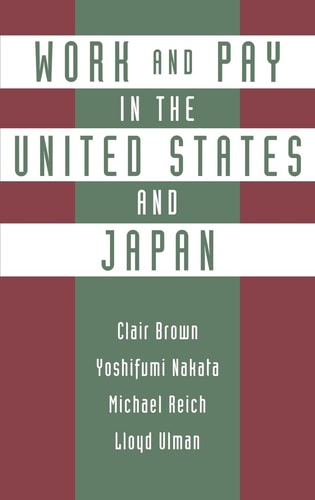
Work and Pay in the United States and Japan
0
0
As an Amazon Associate and affiliate partner, Menrva Books earns from qualifying purchases. Learn more
Author Description
In Work and Pay in the United States and Japan, authors Clair Brown, Yoshifumi Nakata, Michael Reich, and Lloyd Ulman provide an integrated and detailed analysis of the components of firm human resources systems in the US and Japan. Drawing on data obtained from fieldwork in comparable establishments in these two countries, as well as from national sources, this work examines the relationship between company practices and national economic institutions.The authors address a number of key questions about employer-employee relations. How have major Japanese manufacturing companies been able to convert the assurance of "lifetime" employment security into a source of superior employee efficiency and adaptability, when job and income security have been feared as a source of "shirking" and wage inflation in the US? How have higher economic and real wage growth rates been associated with greater equality in earned income distribution in Japan, when the incentive role of income inequality to worker effort and savings has been stressed in the US? How could Japanese emphasis on employment security in the firm be reconciled with greater price stability and lower unemployment than in the US? This work analyzes elements such as employee training and involvement programs, wage behavior as an incentive system and an alternate channel of savings, and synchronous wage determination (shunto) at work in the Japanese economy that provide for such successes.The book also explores the costs that have been associated with these Japanese accomplishments, as well as who must bear them. In particular, it examines how Japanese women compare less favorably with American women in terms of opportunities for work, pay, and promotion; the higher hours of working time for men in Japan than in the US; and the constraints on mobility for Japanese workers. It also poses the question of whether Japanese unions are weaker than their American counterparts, or just more sensible and far-sighted. Finally,
Menrva's Summary
THE THESIS
This work investigates the structural differences between American and Japanese human resource systems to determine how national economic institutions influence firm-level employer-employee relations. The authors, a team of economists and researchers, utilize a comparative framework based on fieldwork in manufacturing establishments and national economic data. They argue that the divergent outcomes in wage growth, employment security, and worker efficiency are rooted in distinct institutional arrangements rather than simple market forces. By analyzing these systems, the text seeks to explain how Japan achieved specific economic successes while identifying the social and individual costs inherent in those models.
THE SCOPE MAP
What You Will Find
- Comparative analysis of firm-level human resource systems in the US and Japan.
- Examination of wage determination mechanisms, including the Japanese shunto system.
- Evaluation of the social costs of employment models, specifically regarding gender inequality and working hours.
- Assessment of the role of labor unions and their influence on worker mobility and economic stability.
THE AUTHORITY PERSPECTIVE
Experts recognize this text as a rigorous comparative study that provides a nuanced look at the institutional underpinnings of labor markets. Readers frequently note the academic density of the prose, which is well-suited for students and professionals in the fields of labor economics and international business.
Page Count:
256
Publication Date:
1997-09-25
Publisher:
Oxford University Press
ISBN-10:
019511521X
ISBN-13:
9780195115215
Business
Economics
International relations
Labor Studies
Sociology
Labor japan
United States
Employees
Community Tags
Similar Books












Reader Comments
Share Your Thoughts
No comments yet. Be the first to share your thoughts!