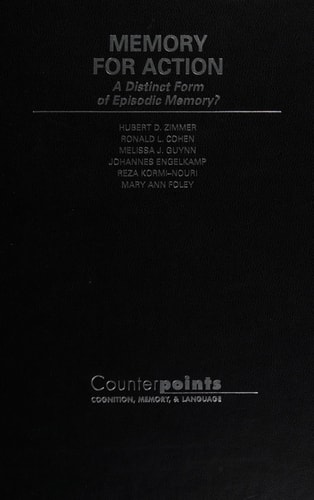
Memory for Action: A Distinct Form of Episodic Memory?
0
0
As an Amazon Associate and affiliate partner, Menrva Books earns from qualifying purchases. Learn more
Author Description
The book presents in eight chapters our actual knowledge on memory for actions and it gives room to the proponents of the opposing models to develop their view for explaining action memory. In Chapter one, Hubert Zimmer and Ronald Cohen summarize the results of laboratory research on action, i. e. memory for self-performed actions. In Chapter two, Melissa Guynn, Mark McDaniel and Gilles Einstein extend this field on memory for intended actions. They present their view on the prospective memory of actions, and they demonstrate the importance of automatic retrieval in prospective memory. In the following chapter, Johannes Engelkamp presents his motor oriented explanation of action memory. He claims that output processes strongly contribute to memory for performed actions, and that the information which is critical for memory is closely related to the information used in the motor control of overt performance. Reza Kormi-Nouri and Lars-Göran Nilsson (Chapter four) completely disagree with this position. They argue that performing actions may cause specific processes, but that nevertheless action memory is part of a unique episodic memory which stores all types of episodes in a similar way. In the following chapter, Mary Ann Foley and Hilary Ratner put action memory in the broader context of activity memory. Everyday actions are usually performed in social contexts and they are goal-oriented. This aspect is seldom relevant in laboratory research, but the authors show that it is of importance for everyday memory. Then two brief chapters follow in which Nilsson and Kormi-Nouri on the one hand, and Engelkamp on the other hand mutually comment on each others position. In the closing chapter, Hubert Zimmer discusses the presented different attempts in parallel. He is doing this by taking into account the different processes and brain modules which are necessary for a successful control of actions.
Menrva's Summary
THE THESIS
This volume investigates whether memory for actions constitutes a distinct cognitive system or if it is merely a component of general episodic memory. The authors, a group of prominent researchers in cognitive psychology, synthesize laboratory findings and theoretical models to evaluate how self-performed actions, prospective intentions, and motor control processes interact within the human brain. By contrasting motor-oriented explanations with episodic-based frameworks, the text provides a comprehensive analysis of the mechanisms underlying action-based recall.
THE SCOPE MAP
What You Will Find
- Comparative analysis of motor-oriented versus episodic memory models.
- Research data on prospective memory and the role of automatic retrieval.
- Discussion on the influence of social and goal-oriented contexts in everyday activity memory.
- Synthesis of neurobiological modules involved in the successful control and storage of actions.
THE AUTHORITY PERSPECTIVE
Experts recognize this work as a significant contribution to the debate surrounding the modularity of memory systems. Researchers frequently cite the text for its balanced presentation of conflicting theoretical positions and its rigorous examination of experimental action memory research.
Page Count:
224
Publication Date:
2001-06-28
Publisher:
Oxford University Press
ISBN-10:
0195115546
ISBN-13:
9780195115543
Psychology
Memory
Neuroscience
Academic
Community Tags
Similar Books








Reader Comments
Share Your Thoughts
No comments yet. Be the first to share your thoughts!