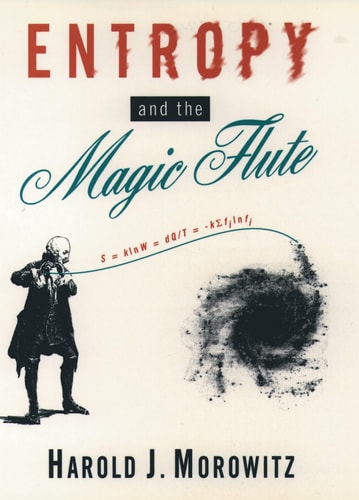
Entropy and the Magic Flute
0
0
As an Amazon Associate and affiliate partner, Menrva Books earns from qualifying purchases. Learn more
Author Description
Harold Morowitz has long been regarded highly both as an eminent scientist and as an accomplished science writer. The essays in The Wine of Life, his first collection, were hailed by C.P. Snow as "some of the wisest, wittiest and best informed that I have read," and Carl Sagan called them "a delight to read." In later volumes such as Mayonnaise and the Origin of Life and The Thermodynamics of Pizza, he has established a reputation for a wide-ranging intellect, an ability to see unexpected connections and draw striking parallels, and a talent for communicating scientific ideas with optimism and wit. Kirkus Reviews praised Mayonnaise as "wonderfully diverting and very wise." Nature wrote of Thermodynamics, "his chocolate-coated nuggets of science will continue to entertain and do surreptitious good." With Entropy and the Magic Flute, Morowitz once again offers an appealing mix of brief reflections on everything from litmus paper to the hippopotamus to the sociology of Palo Alto coffee shops. Many of these pieces are appreciations of scientists that Morowitz holds in high regard. In the title piece, for instance, Morowitz tells of his pilgrimage to the grave of Ludwig Boltzmann, found in the same cemetery - Vienna's Central Cemetery - as the graves of Beethoven, Schubert, and Brahms and the memorial to Mozart. He also writes of J. Willard Gibbs ("thought by many to be the greatest scientist yet produced by the United States"), Jean Perrin (author of Les Atomes, a now-forgotten classic that convinced virtually everyone in science of the validity of the atomic hypothesis), Einstein, Newton (on the occasion of the 300th anniversary of his Principia, a date that passed virtually unnoticed except by Morowitz), Murray Gell-Mann, and Aristotle. Of Aristotle, Morowitz observes that "most people whose information comes from academic philosophy fail to appreciate that - among his many fields of expertise - first and foremost, Aristotle was a biologist."
Menrva's Summary
THE THESIS
This collection of essays investigates the intersection of scientific principles and everyday phenomena to demonstrate the ubiquity of physical laws in the natural and human world. Harold J. Morowitz, a distinguished biophysicist and science communicator, utilizes his extensive background in thermodynamics and biology to bridge the gap between complex theoretical concepts and accessible observation. By examining the lives of historical scientific figures alongside mundane occurrences, he argues that a scientific perspective provides a more profound understanding of the human experience.
THE SCOPE MAP
What You Will Find
- Biographical sketches of influential scientists including Ludwig Boltzmann, J. Willard Gibbs, and Aristotle.
- Explorations of thermodynamic principles applied to diverse subjects ranging from coffee shop sociology to biological systems.
- Historical analysis of scientific milestones such as the publication of Newton's Principia.
- Observations on the philosophical implications of atomic theory and biological classification.
THE AUTHORITY PERSPECTIVE
Critics and readers consistently praise Morowitz for his ability to synthesize complex scientific data with wit and accessible prose. Experts recognize this work as a valuable contribution to the genre of scientific essays, noting its effectiveness in humanizing the history of physics and biology for a general audience.
Page Count:
240
Publication Date:
1996-10-10
Publisher:
Oxford University Press
ISBN-10:
0195111346
ISBN-13:
9780195111347
Science
Biology
Entropy
Essays
Physics
Community Tags
Other Editions(3)

Similar Books







Reader Comments
Share Your Thoughts
No comments yet. Be the first to share your thoughts!