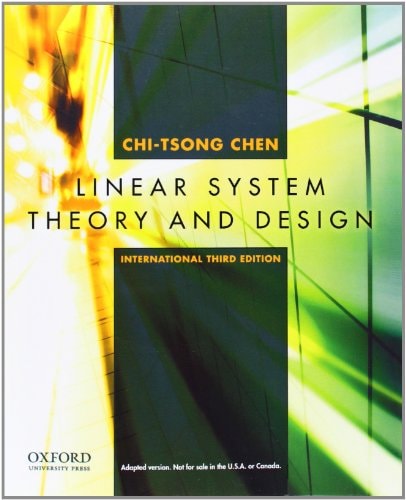
Linear System Theory and Design
0
0
As an Amazon Associate and affiliate partner, Menrva Books earns from qualifying purchases. Learn more
Author Description
With the advancement of technology, engineers need the systems they design not only to work, but to be the absolute best possible given the requirements and available tools. In this environment, an understanding of a system's limitations acquires added importance. Without such knowledge, one might unknowingly attempt to design an impossible system. Thus, a thorough investigation of all of a system's properties is essential. In fact, many design procedures have evolved from such investigations. For use at the senior-graduate level in courses on linear systems and multivariable system design, this highly successful text is devoted to this study and the design procedures developed thereof. It is not a control text, per se--since it does not cover performance criteria, physical constraints, cost, optimization, and sensitivity problems. Chen develops major results and design procedures using simple and efficient methods. Thus, the presentation is not exhaustive; only those concepts which are essential in the development are introduced. Problem sets--following each chapter--help students understand and utilize the concepts and results covered.
Menrva's Summary
THE THESIS
This text investigates the fundamental properties of linear systems to provide engineers with the theoretical framework necessary for effective system design. Chi-Tsong Chen, a recognized authority in control theory, utilizes a streamlined mathematical approach to distinguish between achievable system designs and impossible configurations. By focusing on essential concepts rather than exhaustive proofs, the author provides a methodology for understanding system limitations and developing robust design procedures for senior and graduate-level students.
THE SCOPE MAP
What You Will Find
- Mathematical foundations of linear system theory
- Analysis of system properties and limitations
- Design procedures for multivariable systems
- Problem sets for practical application of theoretical concepts
THE AUTHORITY PERSPECTIVE
Experts and educators frequently cite this work as a foundational text for students transitioning into advanced control theory. Readers often note the clarity of the prose and the efficiency of the mathematical methods presented, which prioritize practical design utility over overly dense theoretical abstraction.
Page Count:
352
Publication Date:
2009-01-01
Publisher:
Oxford University Press
ISBN-10:
0195392078
ISBN-13:
9780195392074
Robotics
New Used & Rental Textbooks
Mathematics
Academic
textbook
Control systems
Engineering
Manufacturing Systems
Community Tags
Other Editions(8)



Similar Books













Reader Comments
Share Your Thoughts
No comments yet. Be the first to share your thoughts!