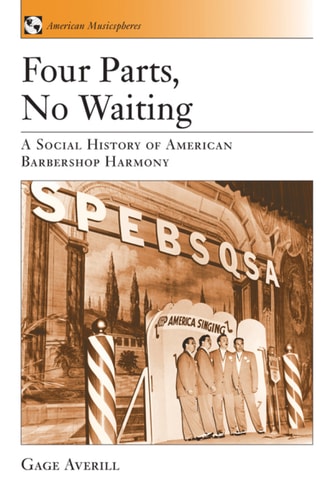
Four Parts, No Waiting: A Social History of American Barbershop Quartet
0
0
As an Amazon Associate and affiliate partner, Menrva Books earns from qualifying purchases. Learn more
Author Description
Four Parts, No Waiting investigates the role that vernacular, barbershop-style close harmony has played in American musical history, in American life, and in the American imagination. Starting with a discussion of the first craze for Austrian four-part close harmony in the 1830s, Averill traces the popularity of this musical form in minstrel shows, black recreational singing, vaudeville, early recordings, and in the barbershop revival of the 1930s. In his exploration of barbershop, Averill uncovers a rich musical tradition--a hybrid of black and white cultural forms, practiced by amateurs, and part of a mythologized vision of small-town American life. Barbershop harmony played a central -- and overlooked -- role in the panorama of American music. Averill demonstrates that the barbershop revival was part of a depression-era neo-Victorian revival, spurred on by insecurities of economic and social change. Contemporary barbershop singing turns this nostalgic vision into lived experience. Arguing that the "old songs" function as repositories of idealized social memory, Averill reveals ideologies of gender, race, and class. This engagingly-written, often funny book critiques the nostalgic myths (especially racial myths) that have surrounded the barbershop revival, but also celebrates the civic-minded, participatory spirit of barbershop harmony. The contents of the CD have been replaced by a companion website with helpful links, resources, and audio examples.
Menrva's Summary
THE THESIS
This book investigates the historical and social significance of barbershop-style close harmony as a central, yet frequently overlooked, component of American musical identity. Author Gage Averill, an ethnomusicologist, utilizes a blend of archival research, musical analysis, and social history to examine how this vernacular tradition evolved from 19th-century roots into a 20th-century cultural phenomenon. He argues that the barbershop revival served as a mechanism for navigating economic and social anxieties during the Great Depression, while simultaneously functioning as a repository for idealized, and often problematic, social memories regarding race, class, and gender.
THE SCOPE MAP
What You Will Find
- A chronological history of four-part harmony from 1830s Austrian influences to the 1930s barbershop revival.
- Analysis of the intersection between black recreational singing, minstrelsy, vaudeville, and the development of the barbershop style.
- Examination of the neo-Victorian ideologies and nostalgic myths embedded within the barbershop movement.
- Critical assessment of how amateur musical participation reflects broader American social structures and civic identity.
THE AUTHORITY PERSPECTIVE
Scholars and music historians frequently cite this work as a foundational text for understanding the intersection of vernacular music and American social history. Readers often note the academic rigor of the prose, which balances detailed musical context with critical sociological analysis of race and class dynamics.
Page Count:
248
Publication Date:
2003-02-20
Publisher:
Oxford University Press
ISBN-10:
0195116720
ISBN-13:
9780195116724
Music
History
Sociology
Singing
American History
Criticism history