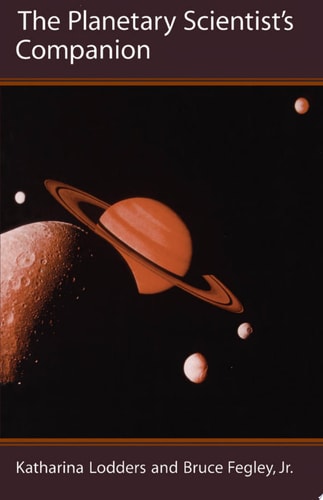
The Planetary Scientist's Companion
0
0
As an Amazon Associate and affiliate partner, Menrva Books earns from qualifying purchases. Learn more
Author Description
Scientists have collected a wealth of physical and chemical data for the Sun, planets, and small bodies in our solar system, but until now this information has been scattered throughout the technical literature. The Planetary Scientist's Companion solves this problem, providing for the first time a single, extensive reference for the interdisciplinary fields of planetary science and cosmochemistry.The book begins with a summary of frequently used physical and chemical constants, unit conversion factors, properties of some compounds and minerals, thermodynamic data, partition coefficients, and useful formulas. This is followed by an overview of the solar system, including comparative data for the planets and their satellites and abundances of the elements. Much of the book is devoted to a series of chapters describing in turn the Sun, each of the planets, and the groups of small bodies (asteroids, comets, meteorites, and Kuiper Belt and Centaur objects). Each chapter includes an introduction, followed by tables of physical and chemical properties compiled from many sources, including data on planetary atmospheres, surfaces, and interiors. The book concludes with data on nearby stars, the interstellar medium, and recently discovered brown dwarfs and possible extrasolar planets, followed by a glossary. A unique and practical resource for anyone interested in contemporary planetary science and cosmochemistry, this volume is likely to be an essential tool in future research.
Menrva's Summary
THE THESIS
This volume addresses the fragmentation of planetary science data by consolidating essential physical and chemical information into a single, comprehensive reference for researchers and students. Authors Bruce Fegley Jr. and Katharina Lodders, both established experts in cosmochemistry and planetary science, synthesize decades of scattered technical literature into a unified framework. The text provides a rigorous collection of constants, thermodynamic data, and comparative planetary metrics designed to facilitate interdisciplinary research across the solar system and beyond.
THE SCOPE MAP
What You Will Find
- A comprehensive collection of physical and chemical constants, unit conversion factors, and thermodynamic data.
- Comparative data sets for the Sun, planets, satellites, and small bodies including asteroids, comets, and meteorites.
- Detailed chapters on planetary atmospheres, surfaces, and internal compositions.
- Supplemental data on nearby stars, the interstellar medium, brown dwarfs, and extrasolar planets.
THE AUTHORITY PERSPECTIVE
Experts and researchers in the field recognize this work as a foundational reference for its systematic organization of complex astronomical data. Readers frequently note the high density of the technical tables and the utility of the volume as a primary resource for ongoing planetary research.
Page Count:
400
Publication Date:
1998-12-10
Publisher:
Oxford University Press
ISBN-10:
0195116941
ISBN-13:
9780195116946
Science
Physics
Planetary Science
Cosmochemistry
Astronomy
Reference
Planets
Chemistry
Community Tags
Similar Books