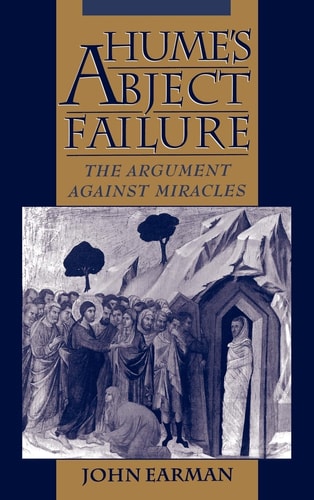
Hume's Abject Failure: The Argument Against Miracles
0
0
As an Amazon Associate and affiliate partner, Menrva Books earns from qualifying purchases. Learn more
Author Description
This vital study offers a new interpretation of Hume's famous "Of Miracles," which notoriously argues against the possibility of miracles. By situating Hume's popular argument in the context of the 18th century debate on miracles, Earman shows Hume's argument to be largely unoriginal and chiefly without merit where it is original. Yet Earman constructively conceives how progress can be made on the issues that Hume's essay so provocatively posed about the ability of eyewitness testimony to establish the credibility of marvelous and miraculous events.
Menrva's Summary
THE THESIS
Does David Hume’s famous argument against the credibility of miracles hold up under rigorous logical and historical scrutiny? John Earman, a distinguished philosopher of science, examines the 18th-century intellectual landscape to evaluate the strength of Hume’s claims. By applying modern probabilistic frameworks to the historical context of the debate, Earman argues that Hume’s position is largely derivative and logically flawed in its original contributions.
THE SCOPE MAP
What You Will Find
- A detailed analysis of the 18th-century philosophical discourse surrounding miraculous events.
- Application of Bayesian probability theory to evaluate eyewitness testimony and historical evidence.
- A critical deconstruction of Hume’s specific arguments regarding the uniformity of nature and the reliability of testimony.
- A constructive proposal for how contemporary philosophy can better address the problem of extraordinary claims.
THE AUTHORITY PERSPECTIVE
Experts in the philosophy of religion and epistemology regard this work as a rigorous challenge to the traditional interpretation of Hume’s essay. Readers frequently note the technical density of the prose, which requires a foundational understanding of probability theory and formal logic to fully appreciate.
Page Count:
232
Publication Date:
2000-11-23
Publisher:
Oxford University Press
ISBN-10:
0195127374
ISBN-13:
9780195127379
Philosophy
Politics
Religion
Categories
Epistemology
History & Surveys
Kindle Store
Logic
Sermons
Miracles
Kindle eBooks
Worship & Devotion
Community Tags
Similar Books