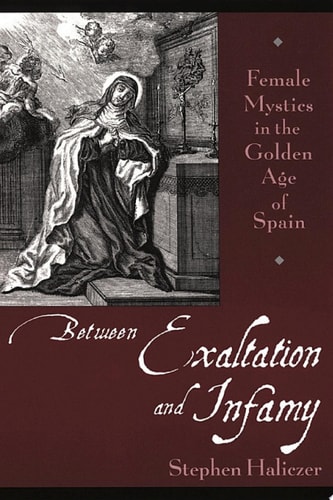
Between Exaltation and Infamy: Female Mystics in the Golden Age of Spain
0
0
As an Amazon Associate and affiliate partner, Menrva Books earns from qualifying purchases. Learn more
Author Description
One day in 1599, in the Spanish village of Saria, seven-year-old Maria Angela Astorch fell ill and died after gorging herself on unripened almonds. Maria's sister Isabel, a nun, came to view the body with her mother superior, an ecstatic mystic and visionary named Maria Angela Serafina. Overcome by the sight of the dead girl's innocent face, Serafina began to pray fervently for the return of the child's soul to her body. Entering a trance, she had a vision in which the Virgin Mary gave her a sign. At once little Maria Angela started to show signs of life. A moment later she scrambled to the ground and was soon restored to perfect health. During the Counter-Reformation, the Church was confronted by an extraordinary upsurge of feminine religious enthusiasm like that of Serafina. Inspired by new translations of the lives of the saints, devout women all over Catholic Europe sought to imitate these "athletes of Christ" through extremes of self-abnegation, physical mortification, and devotion. As in the Middle Ages, such women's piety often took the form of ecstatic visions, revelations, voices and stigmata. Stephen Haliczer offers a comprehensive portrait of women's mysticism in Golden Age Spain, where this enthusiasm was nearly a mass movement. The Church's response, he shows, was welcoming but wary, and the Inquisition took on the task of winnowing out frauds and imposters. Haliczer draws on fifteen cases brought by the Inquisition against women accused of "feigned sanctity," and on more than two dozen biographies and autobiographies. The key to acceptance, he finds, lay in the orthodoxy of the woman's visions and revelations. He concludes that mysticism offered women a way to transcend, though not to disrupt, the control of the male-dominated Church.
Menrva's Summary
THE THESIS
This work investigates the complex relationship between female mystics and the institutional Church in Golden Age Spain, specifically examining how the Inquisition navigated the tension between genuine religious fervor and potential fraud. Stephen Haliczer, a historian specializing in Spanish religious history, utilizes a wealth of primary source material to analyze the social and theological landscape of the Counter-Reformation. He argues that while mysticism provided women a rare avenue for spiritual authority, their influence remained strictly bounded by the requirement of theological orthodoxy as defined by male ecclesiastical authorities.
THE SCOPE MAP
What You Will Find
- Analysis of fifteen Inquisition cases involving accusations of feigned sanctity.
- Examination of over two dozen contemporary biographies and autobiographies of female mystics.
- A detailed look at the cultural phenomenon of feminine religious enthusiasm in 16th and 17th-century Spain.
Scope Limits
- The study focuses primarily on the Spanish experience and does not provide a comparative analysis of mysticism in other Catholic European nations.
- The text does not attempt to verify the supernatural validity of the visions, focusing instead on the institutional and social reception of these claims.
THE AUTHORITY PERSPECTIVE
Historians and scholars of the Counter-Reformation frequently cite this work for its meticulous use of Inquisition records to illuminate the lived experience of women in the early modern period. Readers often note that the text provides a balanced, academic examination of how religious institutions managed the volatile intersection of gender, power, and spiritual authority.
Page Count:
355
Publication Date:
2002-01-01
Publisher:
Oxford University Press
ISBN-10:
0190287519
ISBN-13:
9780190287511
Politics
History
Religion
Mysticism_spain
Kindle Store
Counter-Reformation
Mysticism
Categories
Special Topics
Church Leadership
Women Mystics
European History
Womens Studies
Sacred texts
Kindle eBooks
Women in History
Europe
Church History
Spain
Community Tags
Similar Books