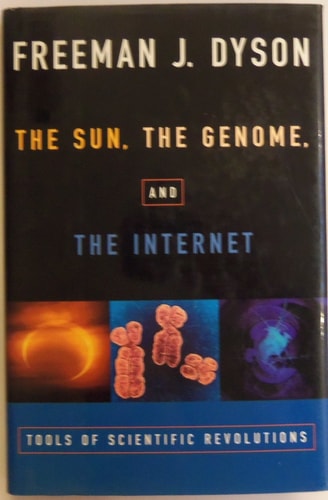
The Sun, the Genome, and the Internet: Tools of Scientific Revolutions
0
0
As an Amazon Associate and affiliate partner, Menrva Books earns from qualifying purchases. Learn more
Author Description
In this visionary look into the future, Freeman Dyson argues that technological changes fundamentally alter our ethical and social arrangements and that three rapidly advancing new technologies--solar energy, genetic engineering, and world-wide communication--together have the potential to create a more equal distribution of the world's wealth.Dyson begins by rejecting the idea that scientific revolutions are primarily concept driven. He shows rather that new tools are more often the sparks that ignite scientific discovery. Such tool-driven revolutions have profound social consequences--the invention of the telescope turning the Medieval world view upside down, the widespread use of household appliances in the 1950s replacing servants, to cite just two examples. In looking ahead, Dyson suggests that solar energy, genetics, and the Internet will have similarly transformative effects, with the potential to produce a more just and equitable society. Solar power could bring electricity to even the poorest, most remote areas of third world nations, allowing everyone access to the vast stores of information on the Internet and effectively ending the cultural isolation of the poorest countries. Similarly, breakthroughs in genetics may well enable us to give our children healthier lives and grow more efficient crops, thus restoring the economic and human vitality of village cultures devalued and dislocated by the global market.Written with passionate conviction about the ethical uses of science, The Sun, the Genome, and the Internet is both a brilliant reinterpretation of the scientific process and a challenge to use new technologies to close, rather than widen, the gap between rich and poor.
Menrva's Summary
THE THESIS
Freeman J. Dyson investigates whether the rapid advancement of solar energy, genetic engineering, and global communication can function as catalysts for a more equitable distribution of global wealth. Dyson, a renowned theoretical physicist, utilizes historical analysis of past technological shifts to argue that scientific progress is driven primarily by the introduction of new tools rather than conceptual breakthroughs. He posits that these three specific technologies possess the capacity to mitigate socioeconomic disparities by providing remote populations with access to information and resources. The work serves as an ethical framework for evaluating the societal impact of emerging scientific capabilities.
THE SCOPE MAP
What You Will Find
- Historical analysis of tool-driven scientific revolutions, including the impact of the telescope and household appliances.
- A framework for evaluating the ethical implications of solar energy, genetic engineering, and the Internet.
- Projections on how decentralized energy and information access can revitalize village-level economies.
- Arguments regarding the potential for technology to bridge the gap between industrialized and developing nations.
THE AUTHORITY PERSPECTIVE
Experts and readers recognize this text as a thoughtful synthesis of physics, history, and social ethics from a prominent scientific mind. The prose is noted for its accessibility and clarity, making complex technological trends understandable for a general audience interested in the intersection of science and human welfare.
Page Count:
144
Publication Date:
1999-05-06
Publisher:
Oxford University Press
ISBN-10:
0195129423
ISBN-13:
9780195129427
Science
Technology
Ethics
Sociology
Future Studies
Internet
Community Tags
Similar Books