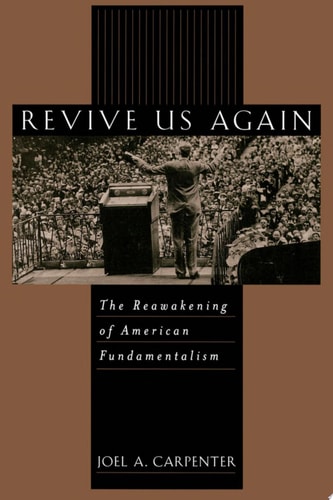
Revive Us Again: The Reawakening of American Fundamentalism
0
0
As an Amazon Associate and affiliate partner, Menrva Books earns from qualifying purchases. Learn more
Author Description
By the end of the 1920s, fundamentalism in America was intellectually bankrupt and publicly disgraced. Bitterly humiliated by the famous Scopes "monkey trial," this once respected movement retreated from the public forum and seemed doomed to extinction. Yet fundamentalism not only survived, but in the 1940s it reemerged as a thriving and influential public movement. And today it is impossible to read a newspaper or watch cable TV without seeing the presence of fundamentalism in American society. In Revive Us Again, Joel A. Carpenter illuminates this remarkable transformation, exploring the history of American fundamentalism from 1925 to 1950, the years when, to non-fundamentalists, the movement seemed invisible.Skillfully blending painstaking research, telling anecdotes, and astute analysis, Carpenter--a scholar who has spent twenty years studying American evangelicalism--brings this era into focus for the first time. He reveals that, contrary to the popular opinion of the day, fundamentalism was alive and well in America in the late 1920s, and used its isolation over the next two decades to build new strength from within. The book describes how fundamentalists developed a pervasive network of organizations outside of the church setting and quietly strengthened the movement by creating their own schools and organizations, many of which are prominent today, including Fuller Theological Seminary and the publishing and radio enterprises of the Moody Bible Institute. Fundamentalists also used youth movements and missionary work and, perhaps most significantly, exploited the burgeoning mass media industry to spread their message, especially through the powerful new medium of radio. Indeed, starting locally and growing to national broadcasts, evangelical preachers reached millions of listeners over the airwaves, in much the same way evangelists preach through television today. All this activity received no publicity outside of fundamentalist channels until Billy Graham bu
Menrva's Summary
THE THESIS
This work investigates how American fundamentalism transitioned from a state of perceived public disgrace in the 1920s to a robust and influential social movement by 1950. Joel A. Carpenter, a scholar specializing in American evangelicalism, utilizes two decades of research to challenge the narrative that the movement vanished following the Scopes trial. He argues that fundamentalists utilized a period of relative isolation to construct a sophisticated, self-sustaining infrastructure of schools, media enterprises, and missionary networks that laid the groundwork for modern evangelical influence.
THE SCOPE MAP
What You Will Find
- A detailed historical analysis of the American fundamentalist movement between 1925 and 1950.
- Examination of the development of independent organizational networks including seminaries and publishing houses.
- Analysis of the strategic adoption of mass media, specifically radio, as a tool for national outreach.
- Case studies on the growth of youth movements and missionary work as mechanisms for internal strengthening.
THE AUTHORITY PERSPECTIVE
Experts recognize this text as a foundational study for understanding the institutional evolution of 20th-century American evangelicalism. Readers frequently note the meticulous archival research and the clarity with which Carpenter documents the movement's transition from the periphery to the public sphere.
Page Count:
368
Publication Date:
1999-07-08
Publisher:
Oxford University Press
ISBN-10:
0195129075
ISBN-13:
9780195129076
Religion
History
Church Leadership
Sociology
Fundamentalism
Categories
Christianity
Kindle Store
Evangelism
Church History
Kindle eBooks
American History
Community Tags
Similar Books