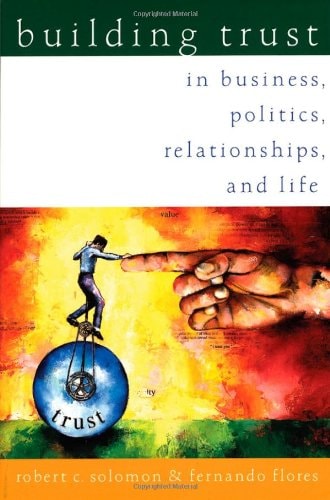
Building Trust: In Business, Politics, Relationships, and Life
0
0
As an Amazon Associate and affiliate partner, Menrva Books earns from qualifying purchases. Learn more
Author Description
Nothing can undermine a relationship more completely than lack of trust. In business, politics, marriage, indeed in any significant relationship, trust is the essential precondition upon which all real success depends. But what, precisely, is trust? How can it be achieved and sustained? And, most importantly, how can it be regained once it has been broken?In Building Trust, Robert C. Solomon and Fernando Flores offer compelling answers to these questions. They argue that trust is not something that simply exists from the beginning, something we can assume or take for granted; that it is not a static quality, or some semi-mystical atmosphere or "social glue." Instead, they assert that trust is an emotional skill, an active and dynamic part of our lives that we build and sustain with our promises and commitments, our emotions and integrity. In looking closely at the effects of mistrust--from insidious office politics that can sabotage a company's efficiency, to national politics rife with cynicism, to marriages that must be protected by prenuptial agreement--Solomon and Flores demonstrate how to move from naïve trust that is easily shattered to an authentic trust that is sophisticated, reflective, and possible to renew. The key to creating such trust, they show, is communication, a willingness to bring an uncomfortable subject into the open where its processes can be analyzed, understood, and rationally negotiated.As the global economy makes us more and more reliant on "strangers," and as our political and personal relationships become more complex, Building Trust offers invaluable insight into a quality none of us can flourish without.
Menrva's Summary
THE THESIS
This book investigates the fundamental nature of trust, questioning how it is constructed, maintained, and restored within professional and personal spheres. The authors, a philosopher and a business consultant, argue against the notion that trust is a static or mystical social glue. Instead, they present a framework defining trust as an active, emotional skill rooted in integrity, commitment, and transparent communication. By analyzing the mechanics of mistrust, they provide a methodology for transitioning from fragile, naive trust to a more resilient and reflective form of authentic engagement.
THE SCOPE MAP
What You Will Find
- Analysis of trust dynamics in corporate environments, political systems, and intimate relationships.
- A conceptual framework for trust as an emotional skill rather than a passive state.
- Examination of the role of promises, commitments, and integrity in building social capital.
- Strategies for repairing broken trust through open communication and rational negotiation.
THE AUTHORITY PERSPECTIVE
Experts and readers frequently cite this work as a foundational text for understanding the intersection of philosophy and organizational behavior. The prose is noted for its analytical rigor, providing a structured approach to a subject often treated with vague sentimentality.
Page Count:
224
Publication Date:
2001-02-15
Publisher:
Oxford University Press
ISBN-10:
0195126858
ISBN-13:
9780195126853
Business
Philosophy
Psychology
Conduct Of Life
Trust
Communication
Relationships
Self Help
Life skills
Principles of Management
Business Ethics
Community Tags
Similar Books