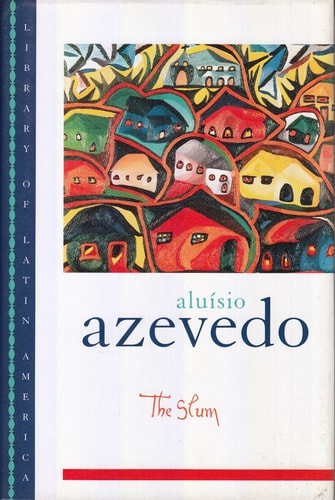
The Slum
0
0
As an Amazon Associate and affiliate partner, Menrva Books earns from qualifying purchases. Learn more
Author Description
First published in 1890, and undoubtedly Azevedo's masterpiece, The Slum is one of the most widely read and critically acclaimed novels ever written about Brazil. Indeed, its great popularity, realistic descriptions, archetypal situations, detailed local coloring, and overall race-consciousness may well evoke Huckleberry Finn as the novel's North American equivalent. Yet Azevedo also exhibits the naturalism of Zola and the ironic distance of Balzac; while tragic, beautiful, and imaginative as a work of fiction, The Slum is universally regarded as one of the best, or truest, portraits of Brazilian society ever rendered.This is a vivid and complex tale of passion and greed, a story with many different strands touching on the different economic tiers of society. Mainly, however, The Slum thrives on two intersecting story lines. In one narrative, a penny-pinching immigrant landlord strives to become a rich investor and then discards his black lover for a wealthy white woman. In the other, we witness the innocent yet dangerous love affair between a strong, pragmatic, "gentle giant" sort of immigrant and a vivacious mulatto woman who both live in a tenement owned by said landlord. The two immigrant heroes are originally Portuguese, and thus personify two alternate outsider responses to Brazil. As translator David H. Rosenthal points out in his useful Introduction: one is the capitalist drawn to new markets, quick prestige, and untapped resources; the other, the prudent European drawn moth-like to "the light and sexual heat of the tropics."A deftly told, deeply moving, and hardscrabble novel that features several stirring passages about life in the streets, the melting-pot realities of the modern city, and the oft-unstable mind of the crowd, The Slum will captivate anyone who might appreciate a more poetic, less political take on the nineteenth-century naturalism of Crane or Dreiser.
Menrva's Summary
THE PULSE
The narrative centers on the volatile social dynamics and moral decay within a crowded Rio de Janeiro tenement, where the pursuit of wealth and carnal desire collide. The story follows two Portuguese immigrants navigating the harsh realities of Brazilian life: one a calculating landlord obsessed with social climbing, and the other a laborer drawn into a perilous romance. Their lives intersect within the claustrophobic confines of the slum, a setting that acts as a living, breathing character that influences the behavior of its inhabitants. Through a third-person omniscient perspective, the novel examines the intersection of economic ambition and the primal instincts of the urban crowd.
INSIDE THE PAGES
- Detailed depiction of nineteenth-century Brazilian urban life
- Exploration of the naturalist literary movement
- Intersecting narrative arcs focusing on class and social mobility
- Vivid characterizations of immigrant archetypes
- Examination of racial and economic tensions in a melting-pot society
- Atmospheric descriptions of the tropical environment
- Analysis of the psychological influence of the crowd
- Ironic commentary on human greed and passion
THE COLLECTIVE ECHO
Readers and critics frequently identify this work as a foundational text of Brazilian literature, often comparing its stylistic rigor to the naturalism of Zola and Balzac. Discussion often centers on the author's unflinching portrayal of the tenement as a microcosm of society, where the environment dictates the moral trajectory of the characters. Many highlight the effectiveness of the dual-protagonist structure, which allows for a broader critique of immigrant experiences and economic exploitation. The novel is widely recognized for its ability to balance gritty, realistic detail with a poetic sensibility that captures the heat and instability of the setting. It remains a primary reference point for those interested in the evolution of nineteenth-century social fiction.
Page Count:
240
Publication Date:
2000-06-01
Publisher:
Oxford University Press
ISBN-10:
0195121864
ISBN-13:
9780195121865
Naturalism
Realism
Historical
Social Commentary
classic
Brazil
Man-woman relationships
Community Tags
Similar Books