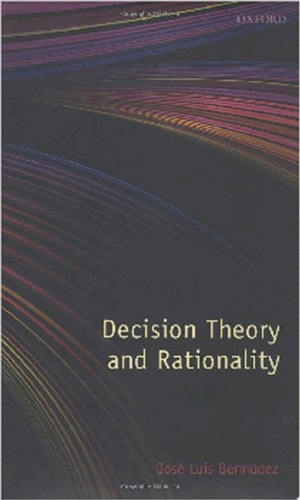
Decision Theory and Rationality
0
0
As an Amazon Associate and affiliate partner, Menrva Books earns from qualifying purchases. Learn more
Author Description
The concept of rationality is a common thread through the human and social sciences -- from political science to philosophy, from economics to sociology, and from management science to decision analysis. But what counts as rational action and rational behavior? José Luis Bermúdez explores decision theory as a theory of rationality. Decision theory is the mathematical theory of choice and for many social scientists it makes the concept of rationality mathematically tractable and scientifically legitimate. Yet rationality is a concept with several dimensions and the theory of rationality has different roles to play. It plays an action-guiding role (prescribing what counts as a rational solution of a given decision problem). It plays a normative role (giving us the tools to pass judgment not just on how a decision problem was solved, but also on how it was set up in the first place). And it plays a predictive/explanatory role (telling us how rational agents will behave, or why they did what they did). This controversial but accessible book shows that decision theory cannot play all of these roles simultaneously. And yet, it argues, no theory of rationality can play one role without playing the other two. The conclusion is that there is no hope of taking decision theory as a theory of rationality.
Menrva's Summary
THE THESIS
Can decision theory serve as a comprehensive and unified theory of human rationality? Author José Luis Bermúdez, a philosopher specializing in the intersection of cognitive science and decision theory, examines the mathematical foundations of choice. He argues that while decision theory provides a rigorous framework for modeling behavior, it fails to simultaneously satisfy the action-guiding, normative, and predictive roles required of a complete theory of rationality.
THE SCOPE MAP
What You Will Find
- Analysis of the three primary roles of rationality: action-guiding, normative, and predictive/explanatory
- Examination of the mathematical tractability of choice in social sciences
- Philosophical critique of decision theory as a universal model for behavior
Scope Limits
- Does not provide a practical manual for making personal life decisions
- Does not cover advanced computational decision algorithms or machine learning applications
THE AUTHORITY PERSPECTIVE
Experts recognize this text as a significant contribution to the philosophy of social science, particularly for its clear articulation of the limitations of formal models. Readers frequently note the academic density of the prose, which is best suited for students and scholars of philosophy, economics, and political science.
Page Count:
212
Publication Date:
2009-01-01
Publisher:
OUP Oxford
ISBN-10:
0191609455
ISBN-13:
9780191609459
Philosophy
Economics
Rationality
Mind & Body
Decision Theory
Decision Making
Reason
Social Science
Logic
Community Tags
Similar Books