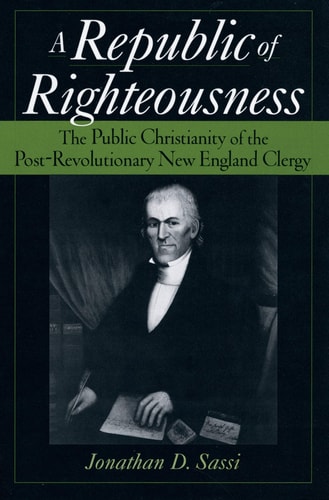
A Republic of Righteousness: The Public Christianity of the Post-Revolutionary New England Clergy
0
0
As an Amazon Associate and affiliate partner, Menrva Books earns from qualifying purchases. Learn more
Author Description
This book examines the debate over the connection between religion and public life in society during the fifty years following the American Revolution. Sassi challenges the conventional wisdom, finding an essential continuity to the period's public Christianity, whereas most previous studies have seen this period as one in which the nation's cultural paradigm shifted from republicanism to liberal individualism. Focusing on the Congregational clergy of New England, he demonstrates that throughout this period there were Americans concerned with their corporate destiny, retaining a commitment to constructing a righteous community and assessing the cosmic meaning of the American experiment.
Menrva's Summary
THE THESIS
This book investigates the evolution of public Christianity in New England during the fifty years following the American Revolution to determine how religious leaders navigated the transition from colonial republicanism to liberal individualism. Jonathan D. Sassi, a scholar of American religious history, utilizes extensive primary source material from Congregational clergy to challenge the prevailing historical narrative. He argues that rather than a sudden shift toward secular individualism, there remained a persistent, robust commitment to the concept of a righteous, corporate community among post-revolutionary religious leaders.
THE SCOPE MAP
What You Will Find
- Analysis of the post-revolutionary transition from republicanism to liberal individualism
- Examination of Congregational clergy discourse and public sermons
- Primary source research focusing on New England religious institutions
- Evaluation of the American experiment through the lens of cosmic and corporate destiny
THE AUTHORITY PERSPECTIVE
Historians and scholars of American religious history recognize this work as a significant contribution to the study of early national identity and the role of the clergy in public life. Readers frequently note the academic density of the prose and the author's meticulous attention to the nuances of theological rhetoric during the early republic.
Page Count:
320
Publication Date:
2001-10-11
Publisher:
Oxford University Press
ISBN-10:
019512989X
ISBN-13:
9780195129892
Religion
History
American History
Church History
Christianity