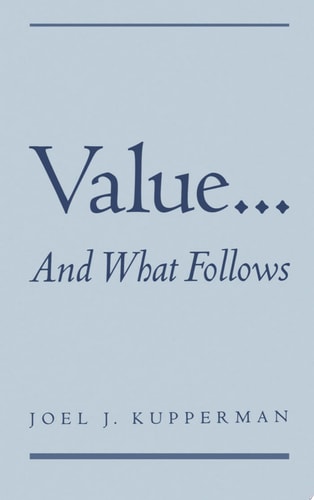
Value... and What Follows
0
0
As an Amazon Associate and affiliate partner, Menrva Books earns from qualifying purchases. Learn more
Author Description
How can we know what is worth seeking or avoiding in life? Is there anything to know? If so, is it in some sense personal? This fresh and engaging work by noted philosopher Joel Kupperman addresses these questions as it examines the epistemology of value.Kupperman looks first at how judgments of values manifest themselves, whether there can be evidence for them, and whether a realistic account is appropriate. Focusing on emotional states, he rejects the notion that there is one primary value, arguing instead for a pluralistic understanding of value. He contends that value is strongly contextual; the value of a particular set of experiences in one's life can depend heavily on how they fit in with or provide contrast to other elements. Kupperman argues both for a realistic account of value--some things really do have a value about which we can have reasonable confidence--and for skepticism about how much we can actually know about value.The study moves on to explore the relations between judgments of value, and moral or social policy decisions of how we should behave. Acknowledging strong objections to the attempt by any group to impose its vision of a good life in a pluralistic society, Kupperman nevertheless argues that proper attention to value leads to perfectionism in social policy. Emphasizing the importance of detail in ethics, he focuses on variations among cases, and examines the weight cultural values can have in the social policy of a liberal society.Going further than previous works in determining what counts as evidence for a judgment of value, this book fills a substantial gap in the literature of ethical philosophy. Tackling difficult issues in an accessible manner, it will interest philosophers and students of ethics, epistemology, and social theory.
Menrva's Summary
THE THESIS
This work investigates the fundamental question of how individuals can determine what is worth seeking or avoiding in life through an examination of the epistemology of value. Joel J. Kupperman, a noted philosopher, utilizes a framework that balances realism with skepticism to argue that value is inherently pluralistic and contextual. By rejecting the notion of a single primary value, he explores how emotional states and life experiences contribute to a nuanced understanding of what constitutes a meaningful existence.
THE SCOPE MAP
What You Will Find
- An analysis of how value judgments manifest and the potential for evidence-based evaluation.
- A critique of monistic value theories in favor of a pluralistic, contextual approach.
- An exploration of the intersection between personal value judgments and moral or social policy.
- A discussion on the role of perfectionism and cultural influence within the framework of a liberal society.
THE AUTHORITY PERSPECTIVE
Philosophers and students of ethics frequently cite this text for its ability to bridge the gap between abstract epistemological inquiry and practical social policy. Experts highlight the work as a significant contribution to the literature, noting its accessible approach to complex debates regarding the objectivity of value.
Page Count:
176
Publication Date:
1998-12-31
Publisher:
Oxford University Press
ISBN-10:
0195123484
ISBN-13:
9780195123487
Philosophy
Non-Fiction
Social Theory
Ethics
Epistemology
Values
Community Tags
Other Editions(2)
Similar Books