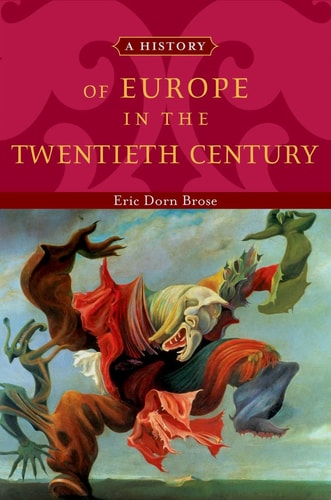
A History of Europe in the Twentieth Century
0
0
As an Amazon Associate and affiliate partner, Menrva Books earns from qualifying purchases. Learn more
Author Description
This last century of European history is situated between a violent and authoritarian past and the dawn of a more democratic and peaceful period--an era that may represent the future. Written in a vivid and accessible style, A History of Europe in the Twentieth Century examines the continent's descent into the turmoil of two world wars, the tense cold war standoff between the victors, and finally the beginning of a more tranquil and egalitarian age. Rather than viewing Europe's history from an outdated perspective colored by cold war ideology, Eric Dorn Brose discusses these topics from a contemporary point of view, looking backward at the total impact of major events on the European world.A History of Europe in the Twentieth Century is organized chronologically around five main themes:* war and the quest for alternatives* ethnic and racial belligerency and the effort to create harmony* authoritarianism and the struggle for democracy* technological revolutions and systems* elite and popular cultureThis thematic approach allows students to focus on separate specific aspects of the history of this troubled century, while striving for a composite view. Brose also dedicates special subsections of the text to extensive discussions of the peace movement, gender relations, the Holocaust, cultural developments, the rise of the EU, and today's terrorist threats. Each chapter begins with a vignette related to chapter themes and subject matter. There is also a historiographical component to A History of Europe in the Twentieth Century, making it ideal for upper-level undergraduate and graduate courses in twentieth-century Europe.
Menrva's Summary
THE THESIS
This work investigates the trajectory of European development throughout the twentieth century, questioning how the continent transitioned from extreme authoritarian violence to a more democratic and integrated political landscape. Eric Dorn Brose, a scholar of European history, utilizes a contemporary analytical framework to synthesize the total impact of major geopolitical events. By moving beyond Cold War-era historiography, the author provides a comprehensive assessment of the forces that shaped modern Europe, including the aftermath of two world wars and the subsequent evolution of the European Union.
THE SCOPE MAP
What You Will Find
- A chronological analysis of twentieth-century European history organized around five core themes: war, ethnic relations, authoritarianism, technology, and culture.
- Specialized subsections covering the Holocaust, gender relations, the peace movement, and modern security threats.
- A historiographical methodology that incorporates chapter-opening vignettes to contextualize complex historical themes.
- A structured academic approach designed for upper-level undergraduate and graduate study.
THE AUTHORITY PERSPECTIVE
Experts and educators frequently identify this text as a balanced, thematic resource for advanced students of European history. Readers often note the clarity of the prose, which successfully synthesizes dense historical data into a coherent narrative for academic use.
Page Count:
548
Publication Date:
2004-09-23
Publisher:
Oxford University Press
ISBN-10:
0195135717
ISBN-13:
9780195135718
History
Twentieth Century
European History
War Studies
Community Tags
Similar Books