
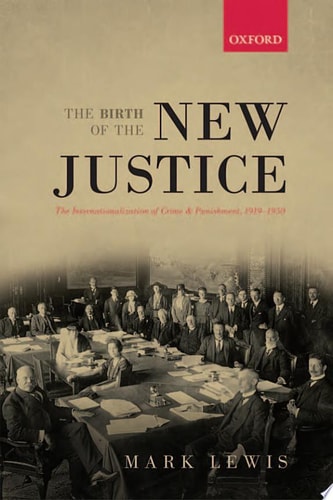
The Birth of the New Justice: The Internationalization of Crime and Punishment, 1919-1950
0
0
As an Amazon Associate and affiliate partner, Menrva Books earns from qualifying purchases. Learn more
Author Description
The Birth of the New Justice is a history of the attempts to instate ad hoc and permanent international criminal courts and new international criminal laws from the end of World War I to the beginning of the Cold War. The purpose of these courts was to repress aggressive war, war crimes, terrorism, and genocide.Rather than arguing that these legal projects were attempts by state governments to project a "liberal legalism" and create an international state system that limited sovereignty, Mark Lewis shows that European jurists in a variety of transnational organizations derived their motives from a range of ideological motives - liberal, conservative, utopian, humanitarian, nationalist, and particularist. European jurists at the Paris Peace Conference in 1919 created a controversial new philosophy of prosecution and punishment, and during the following decades, jurists in different organizations, including the International Law Association, International Association for Criminal Law, the World Jewish Congress, and the International Committee of the Red Cross, transformed the ideas of the legitimacy of post-war trials and the concept of international crime to deal with myriad social and political problems. The concept of an international criminal court was never static, and the idea that national tribunals would form an integral part of an international system to enforce new laws was frequently advanced as a pragmatic-and politically convenient-solution.The Birth of the New Justice shows that legal organizations were not merely interested in ensuring that the guilty were punished or that international peace was assured. They hoped to instill particular moral values, represent the interests of certain social groups, and even pursue national agendas. At the same time, their projects to define new types of crimes and ensure that old ones were truly punished also sprang from hopes that a new international political and moral order would check the power of the sovereign na
Menrva's Summary
THE THESIS
This work investigates the evolution of international criminal law and the establishment of ad hoc and permanent courts between 1919 and 1950. Mark A. Lewis, a historian of modern Europe, challenges the conventional view that these legal projects were merely instruments of state-led liberal legalism. Instead, he argues that European jurists were driven by a complex, often contradictory array of ideological motivations—ranging from humanitarianism and utopianism to nationalism and conservatism—as they sought to redefine the legitimacy of post-war trials and international justice.
THE SCOPE MAP
What You Will Find
- Historical analysis of international legal projects from the Paris Peace Conference to the early Cold War.
- Examination of the roles played by organizations such as the International Law Association, the World Jewish Congress, and the International Committee of the Red Cross.
- A study of the shifting definitions of international crimes, including aggressive war, terrorism, and genocide.
- Exploration of the tension between national sovereignty and the desire for a unified international criminal justice system.
THE AUTHORITY PERSPECTIVE
Scholars and historians recognize this text as a significant contribution to the understanding of how transnational legal networks shaped the twentieth-century political order. Readers frequently note the meticulous archival research and the author's ability to navigate the complex ideological landscape of European jurists during the interwar period.
Page Count:
360
Publication Date:
2016-10-11
Publisher:
Oxford University Press
ISBN-10:
0198783256
ISBN-13:
9780198783251
History
Courts_europe
Twentieth Century
International Law
Modern History
European History
Law
War Crimes
Community Tags
Other Editions(2)
Similar Books













Reader Comments
Share Your Thoughts
No comments yet. Be the first to share your thoughts!