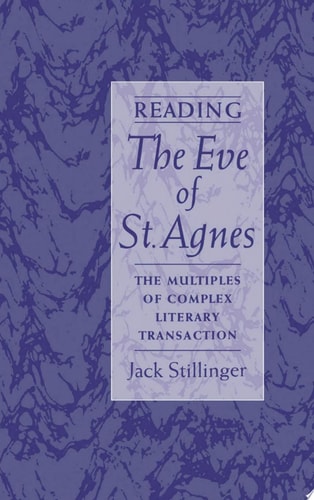
Reading The Eve of St. Agnes: The Multiples of Complex Literary Transaction
0
0
As an Amazon Associate and affiliate partner, Menrva Books earns from qualifying purchases. Learn more
Author Description
Using the 180-year history of Keats's Eve of St. Agnes as a basis for theorizing about the reading process, Stillinger's book explores the nature and whereabouts of "meaning" in complex works. A proponent of authorial intent, Stillinger argues a theoretical compromise between author and reader, applying a theory of interpretive democracy that includes the endlessly multifarious reader's response as well as Keats's guessed-at intent. Stillinger also considers the process of constructing meaning, and posits an answer to why Keats's work is considered canonical, and why it is still being read and admired.
Menrva's Summary
THE THESIS
This book investigates the nature of meaning in complex literary works by using the 180-year reception history of John Keats's poem 'The Eve of St. Agnes' as a primary case study. Jack Stillinger, a scholar of Romantic literature, utilizes this historical framework to propose a theory of 'interpretive democracy.' He argues that meaning is not solely the product of authorial intent, but rather a collaborative transaction between the author's original creative vision and the multifarious, evolving responses of the reading public over time.
THE SCOPE MAP
What You Will Find
- A detailed historical analysis of the critical reception of 'The Eve of St. Agnes' spanning nearly two centuries.
- A theoretical framework for balancing authorial intent with reader-response criticism.
- An exploration of the mechanisms behind the construction of literary canonization.
- An examination of why specific complex texts maintain their status and relevance for successive generations of readers.
THE AUTHORITY PERSPECTIVE
Scholars frequently cite this work as a significant contribution to the study of Romanticism and the philosophy of literary interpretation. Experts highlight Stillinger's balanced approach as a foundational text for understanding the tension between historical context and modern reader subjectivity.
Page Count:
200
Publication Date:
1999-10-14
Publisher:
Oxford University Press
ISBN-10:
0195130227
ISBN-13:
9780195130225
Poetry
Academic
Literary theory
Literary Criticism