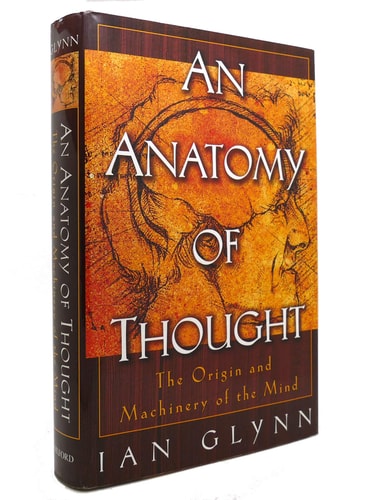
An Anatomy of Thought: The Origin and Machinery of the Mind
0
0
As an Amazon Associate and affiliate partner, Menrva Books earns from qualifying purchases. Learn more
Author Description
Drawing on a dazzlingly wide array of disciplines--physiology, neurology, psychology, anthropology, linguistics, and philosophy--Ian Glynn explains virtually every aspect of the workings of the brain, unlocking the mysteries of the mind.Here are the mechanics of nerve messages; the functioning of sensory receptors; the processes by which the brain sees, tastes, and smells; the seats of language, memory, and emotions. Glynn writes with exceptional clarity and offers telling examples: to help explain vision, for instance, he discusses optical illusions as well as cases of patients who suffer disordered seeing through healthy eyes (such as the loss of the ability to recognize familiar faces). The breadth of Glynn's erudition is astonishing, as he ranges from parallel processing in computers to the specialization of different regions of the brain (illustrated with fascinating instances of the bizarre effects of localized brain damage). He explains the different types of memory (episodic and semantic, as well as short-term and implicit memory), traces the path through the brain of information leading to emotional responses, and engages in a discussion of language that takes in Noam Chomsky and Hawaiian pidgin. Moreover, for every subject Glynn addresses, he offers a thorough-going scientific history. For example, before discussing the evolution of the brain, he provides an account of the theory of evolution itself, from the writing and success of The Origin of Species to recent work on the fossil record, DNA, and RNA.No other single volume has captured the full expanse of our knowledge of consciousness and the brain. A work of unequaled authority and eloquence, An Anatomy of Thought promises to be a new landmark of scientific writing.
Menrva's Summary
THE THESIS
What are the biological and evolutionary mechanisms that constitute the human mind and consciousness? Ian Glynn, a distinguished physiologist, synthesizes decades of research across neurology, linguistics, and anthropology to construct a comprehensive framework of brain function. By integrating historical scientific context with contemporary neurological data, he maps the complex relationship between physical neural architecture and cognitive experience.
THE SCOPE MAP
What You Will Find
- Detailed analysis of sensory processing, including vision, taste, and smell mechanisms.
- Examination of memory systems, distinguishing between episodic, semantic, and implicit storage.
- Historical accounts of evolutionary theory and its application to brain development.
- Case studies of localized brain damage to illustrate functional specialization.
THE AUTHORITY PERSPECTIVE
Experts and readers alike recognize this work as a comprehensive synthesis of brain science that balances technical detail with accessible prose. The text is frequently cited for its ability to bridge the gap between historical scientific development and modern neurological understanding.
Page Count:
464
Publication Date:
2000-04-27
Publisher:
Oxford University Press
ISBN-10:
0195136969
ISBN-13:
9780195136968
Philosophy
Non-Fiction
Psychology
Science
Brain
Cognition
History of Psychology
Neuroscience
Biology
Community Tags
Similar Books