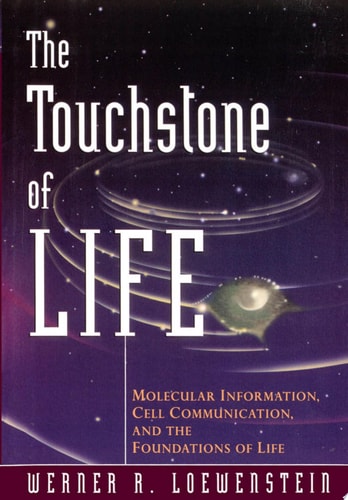
The Touchstone of Life: Molecular Information, Cell Communication, and the Foundations of Life
0
0
As an Amazon Associate and affiliate partner, Menrva Books earns from qualifying purchases. Learn more
Author Description
No one can escape a sense of wonder when looking at an organism from within. From the humblest amoeba to man, from the smallest cell organelle to the amazing human brain, life presents us with example after example of highly ordered cellular matter, precisely organized and shaped to perform coordinated functions. But where does this order spring from? How does a living organism manage to do what nonliving things cannot do--bring forth and maintain all that order against the unrelenting, disordering pressures of the universe? In The Touchstone of Life, world-renowned biophysicist Werner Loewenstein seeks answers to these ancient riddles by applying information theory to recent discoveries in molecular biology. Taking us into a fascinating microscopic world, he lays bare an all-pervading communication network inside and between our cells--a web of extraordinary beauty, where molecular information flows in gracefully interlaced circles. Loewenstein then takes us on an exhilarating journey along that web and we meet its leading actors, the macromolecules, and see how they extract order out of the erratic quantum world; and through the powerful lens of information theory, we are let in on their trick, the most dazzling of magician's acts, whereby they steal form out of formlessness. The Touchstone of Life flashes with fresh insights into the mystery of life. Boldly straddling the line between biology and physics, the book offers a breathtaking view of that hidden world where molecular information turns the wheels of life. Loewenstein makes these complex scientific subjects lucid and fascinating, as he sheds light on the most fundamental aspects of our existence.
Menrva's Summary
THE THESIS
This book investigates the fundamental mechanisms by which living organisms generate and maintain biological order against the entropic pressures of the universe. Werner R. Loewenstein, a distinguished biophysicist, utilizes the framework of information theory to analyze molecular communication networks within and between cells. By synthesizing recent discoveries in molecular biology with physical principles, he argues that the flow of information is the primary driver of biological structure and function.
THE SCOPE MAP
What You Will Find
- Analysis of molecular communication networks within cellular organelles
- Application of information theory to biological systems
- Examination of macromolecular interactions at the quantum level
- Discussion on the origins of biological order and complexity
Scope Limits
- The text does not provide a comprehensive history of evolutionary biology
- It does not cover clinical applications or medical treatments
THE AUTHORITY PERSPECTIVE
Experts recognize this work as a significant attempt to bridge the gap between biophysics and information theory for a general audience. Readers frequently note that while the prose is accessible, the conceptual density requires careful attention to grasp the underlying scientific arguments.
Page Count:
384
Publication Date:
1999-01-01
Publisher:
Oxford University Press
ISBN-10:
0190283629
ISBN-13:
9780190283629
Philosophy
Science
Information Theory
Philosophy of
Biology
Biophysics
Community Tags
Similar Books