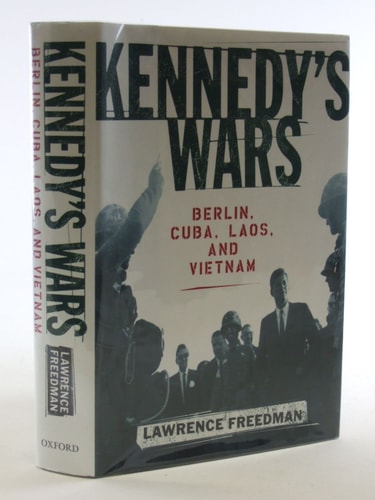
Kennedy's Wars: Berlin, Cuba, Laos, and Vietnam
0
0
As an Amazon Associate and affiliate partner, Menrva Books earns from qualifying purchases. Learn more
Author Description
In his thousand-day presidency, John F. Kennedy led America through one of its most difficult and potentially explosive eras. With the Cold War at its height and the threat of communist advances in Europe and the Third World, Kennedy had the unenviable task of sustaining political support at home without leading the western world into a nuclear catastrophe. In Kennedy's Wars, noted historian Lawrence Freedman draws on the best of Cold War scholarship and newly released government documents to illuminate Kennedy's approach to war and his efforts for peace. He recreates insightfully the political and intellectual milieu of the foreign policy establishment during Kennedy's era with vivid profiles of his top advisors - Robert McNamara, Dean Rusk, Robert Kennedy - and influential figures such as Dean Acheson and Walt Rostow. Tracing the evolution of traditional liberalism into the Cold War liberalism of Kennedy's cabinet, Freedman evaluates their responses to the tensions in Berlin, Cuba, Laos, and Vietnam. He gives each conflict individual attention, showing how foreign policy decisions came to be defined for each new crisis in the light of those that had gone before. Readers will follow Kennedy as he wrestles with a succession of major conflicts - taking advice, weighing the risks of inadvertantly escalating the Cold War into outright military confrontation, and exploring diplomatic options. Freedman explains the strategic judgments that served to prevent a major war during Kennedy's presidency. Kennedy's Wars offers a dynamic and human portrait of Kennedy under pressure: a political leader shaped by the ideas of his time, conscious of his vulnerability to electoral defeat but also of his nation's vulnerability to nuclear war. Military and Kennedy enthusiasts will find its balanced consideration of the president's foreign policy and provocative "what if" scenarios invaluable keys to understanding his accomplishments, failures, and enduring legacy.
Menrva's Summary
THE THESIS
How did John F. Kennedy navigate the precarious balance between aggressive Cold War containment and the avoidance of nuclear catastrophe during his presidency? Lawrence Freedman, a distinguished scholar of international relations and military history, utilizes newly declassified government documents and extensive Cold War scholarship to analyze the decision-making processes of the Kennedy administration. The book examines the intellectual framework of 'Cold War liberalism' that guided Kennedy and his cabinet, assessing how these ideological commitments influenced their responses to global crises.
THE SCOPE MAP
What You Will Find
- Detailed analysis of foreign policy crises in Berlin, Cuba, Laos, and Vietnam.
- Profiles of key administration figures including Robert McNamara, Dean Rusk, and Robert Kennedy.
- Examination of the transition from traditional liberalism to Cold War interventionist policy.
- Evaluation of strategic judgments and diplomatic maneuvers used to prevent direct military confrontation.
THE AUTHORITY PERSPECTIVE
Historians and political scientists frequently cite this work as a balanced and rigorous examination of Kennedy's foreign policy legacy. Experts highlight the text for its ability to synthesize complex geopolitical tensions into a coherent narrative of presidential decision-making.
Page Count:
560
Publication Date:
2000-10-19
Publisher:
Oxford University Press
ISBN-10:
0195134532
ISBN-13:
9780195134537
History
Biography
Cold War
United States
20th Century
Military History
Community Tags
Similar Books