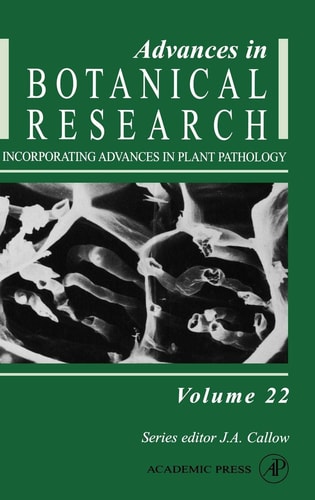
Advances in Botanical Research: Vol. 22
0
0
As an Amazon Associate and affiliate partner, Menrva Books earns from qualifying purchases. Learn more
Author Description
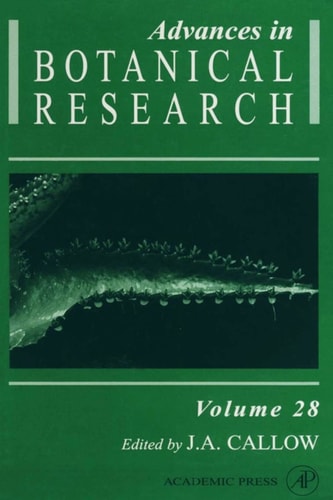
Harmonious, integrated functioning of the whole plant system requires that its various cells, tissues and organs should be able to communicate with each other, transferring a range of information on environmental conditions, physiological and microbial stresses etc. In this volume of Advances in Botanical Research incorporating Advances in Plant Pathology three articles are concerned with different aspects of plant signalling.McDonald and Davis consider how shoot systems respond to drying and N-deficient soil, in terms of their stomatal behaviour and growth, via the transmission of root-derived chemical signals. Malone considers the major hypotheses that have been proposed with particular attention being given to hydraulic pressure signals and the hydraulic dispersal of chemical signals. At a different, intracellular level of communication, a wide variety of second messengers couple extracellular stimuli to a characteristic physiological response. Webb et al. Consider progress made in establishing similar roles for calcium in plant signalling in the context of the mammalian paradigms.The effects of UV-B radiation on plants have been extensively investigated in recent years. Jordan considers progress in understanding the chain of events from perception of UV-B to signal transduction and consequent changes in gene expression and regulation.Smith and Smith assess the various hypotheses erected over the years to explain structure and function of the host-parasite interface formed by vesticular-arbuscular (VA) mycorrhizas, an important and widespread mutualistic symbioses of a wide range of higher and some lower plants.
Menrva's Summary
THE THESIS
This volume investigates the complex mechanisms of plant signaling and environmental response, focusing on how internal and external stimuli are processed at cellular and systemic levels. Edited by J. A. Callow, this collection of academic articles synthesizes research on plant communication, stress responses, and symbiotic interfaces. The contributors utilize physiological data and comparative biological frameworks to evaluate how plants perceive and adapt to environmental stressors such as UV-B radiation and soil nutrient deficiency.
THE SCOPE MAP
What You Will Find
- Analysis of root-to-shoot chemical signaling in response to soil conditions
- Examination of hydraulic pressure signals and chemical dispersal mechanisms
- Review of calcium-mediated intracellular signaling pathways
- Assessment of UV-B radiation perception and gene expression regulation
- Evaluation of host-parasite interface structures in mycorrhizal symbioses
Scope Limits
- Does not provide a comprehensive overview of all botanical research fields
- Focuses strictly on specific signaling and stress-response pathways rather than general plant taxonomy or anatomy
THE AUTHORITY PERSPECTIVE
Experts and researchers in plant biology utilize this volume as a specialized reference for understanding the state of signaling research during the mid-1990s. Readers frequently note the academic density of the prose, which is tailored specifically for professionals and graduate-level students in the botanical sciences.
Page Count:
328
Publication Date:
1996-04-09
Publisher:
Academic Press
ISBN-10:
0120059223
ISBN-13:
9780120059225
Science
Academic Research
Botany
Plant Pathology
Biological Sciences & Nutrition - Biology - Botany
Community Tags
Similar Books