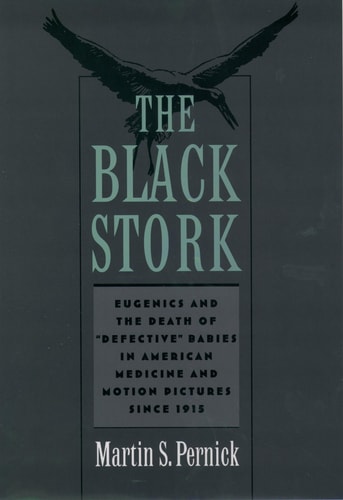
The Black Stork: Eugenics and the Death of 'Defective' Babies in American Medicine and Motion Pictures since 1915
0
0
As an Amazon Associate and affiliate partner, Menrva Books earns from qualifying purchases. Learn more
Author Description
In the late 1910s Dr. Harry J. Haiselden, a prominent Chicago surgeon, electrified the nation by allowing the deaths of at least six infants he diagnosed as "defectives". He displayed the dying infants to journalists, wrote about them for the Hearst newspapers, and starred in a feature film about his crusade. Prominent Americans from Clarence Darrow to Helen Keller rallied to his support. Martin Pernick tells this captivating story--uncovering forgotten sources and long-lost motion pictures--in order to show how efforts to improve human heredity (eugenics) became linked with mercy killing, as well as with race, class, gender and ethnicity. It documents the impact of cultural values on science along with the way scientific claims of objectivity shape modern culture. While focused on early 20th century America, The Black Stork traces these issues from antiquity to the rise of Nazism, and to the "Baby Doe", "assisted suicide" and human genome initiative debates of today.
Menrva's Summary
THE THESIS
This book investigates the intersection of eugenics, medical ethics, and popular culture through the case study of Dr. Harry J. Haiselden and his controversial practice of allowing infants diagnosed as defective to die. Martin S. Pernick, a historian of medicine, utilizes archival records, newspaper accounts, and the recovered film The Black Stork to analyze how early 20th-century American society integrated eugenic ideology into medical practice. He argues that scientific claims of objectivity are frequently influenced by prevailing cultural values regarding race, class, and disability. The work provides a framework for understanding how these historical attitudes inform contemporary debates surrounding assisted suicide and genetic engineering.
THE SCOPE MAP
What You Will Find
- Historical analysis of the eugenics movement in the United States from 1915 through the mid-20th century.
- Examination of the role of mass media and motion pictures in shaping public perception of medical ethics.
- Primary source evidence including newspaper reports, medical records, and the film The Black Stork.
- Comparative study linking early 20th-century practices to modern debates on the human genome and end-of-life care.
THE AUTHORITY PERSPECTIVE
Historians and medical ethicists frequently cite this work as a foundational text for understanding the cultural history of eugenics in American medicine. Scholars note the meticulous research and the author's ability to connect historical medical practices to broader societal shifts in values.
Page Count:
328
Publication Date:
1999-07-22
Publisher:
Oxford University Press
ISBN-10:
0195135393
ISBN-13:
9780195135398
History
Science
Sociology
Ethics
Motion pictures
Medicine
Eugenics
Community Tags
Similar Books