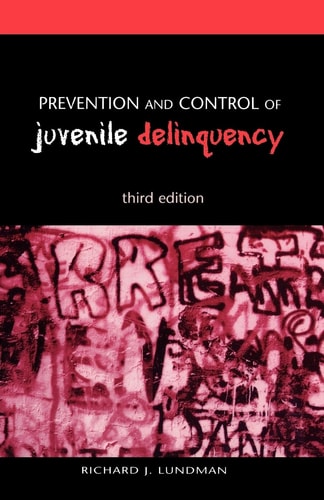
Prevention and Control of Juvenile Delinquency
0
0
As an Amazon Associate and affiliate partner, Menrva Books earns from qualifying purchases. Learn more
Author Description
This remarkably successful book is the most comprehensive and accessible examination available of the various methods for the prevention and control of juvenile delinquency. Now in its third edition, this popular work has been thoroughly updated to cover all major recent trends in the field. It includes an analysis of the neighborhood and individual-level origins of juvenile delinquency and contains new chapters on DARE programs for children and adolescents and boot camps for juvenile offenders. Other chapters have been substantially updated, including the chapter on diversion, which now covers the serious problem of minority overrepresentation in the juvenile justice system.Prevention and Control of Juvenile Delinquency pays particular attention to the important projects that have fundamentally shaped the thoughts and actions of persons concerned with youth crime. The third edition contains recent extensions and replications of previously examined projects and sensitizes students to the conditions that must be met to determine whether or not a project has accomplished its goal. The author offers a rigorous and logical justification of his recommendations for the future, linking what has been done in the past with what should be done in the future, especially his provocative argument in favor of doing less rather than more to juveniles in trouble with the law.Careful scholarship, exceptional writing, and over 100 illustrations, tables, and boxes make this book essential for a wide range of courses in sociology, criminology, criminal justice, public policy, administration of justice, social work, psychology, and law enforcement. Prevention and Control of Juvenile Delinquency now offers students an even more detailed understanding of this important topic.
Menrva's Summary
THE THESIS
This text investigates the efficacy of various intervention and control strategies designed to address juvenile delinquency within the justice system. Richard J. Lundman, a scholar in the field of criminology, utilizes a synthesis of historical project data and sociological analysis to evaluate past and present approaches to youth crime. The author presents a framework that challenges conventional punitive measures, ultimately arguing for a more restrained approach to juvenile intervention.
THE SCOPE MAP
What You Will Find
- Analysis of neighborhood and individual-level origins of delinquent behavior
- Evaluation of specific programs including DARE and juvenile boot camps
- Examination of systemic issues such as minority overrepresentation in the justice system
- Methodological criteria for assessing the success or failure of delinquency prevention projects
THE AUTHORITY PERSPECTIVE
Experts and educators frequently cite this work as a foundational text for students in sociology and criminal justice programs. The prose is noted for its academic rigor while remaining accessible to those entering the field of social work or law enforcement.
Page Count:
336
Publication Date:
2001-07-12
Publisher:
Oxford University Press
ISBN-10:
0195135458
ISBN-13:
9780195135459
Psychology
Social Work
Criminology
Public Policy
Sociology
Community Tags
Other Editions(3)

Similar Books











Reader Comments
Share Your Thoughts
No comments yet. Be the first to share your thoughts!