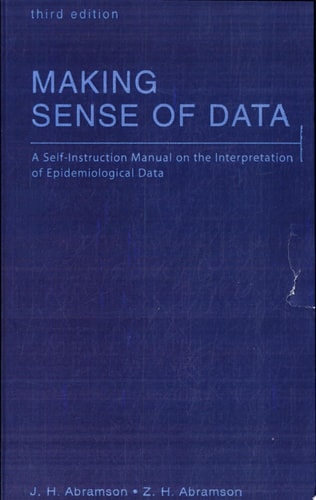
Making Sense of Data: A Self-Instruction Manual on the Interpretation of Epidemiological Data
0
0
As an Amazon Associate and affiliate partner, Menrva Books earns from qualifying purchases. Learn more
Author Description
This self-instructional manual on the interpretation and use of epidemiologic data deals with the basic concepts and skills needed for the appraisal of published reports or one's own findings. Applications in clinical medicine, public health, community medicine, and research are all taken into consideration. Making Sense of Data is designed as a workbook of short exercises and instructional self-tests that introduce fundamental approaches and procedures in data interpretation and develop competency in working with epidemiologic tools. Basic concepts are presented in the first section, which also demonstrates the step-by-step assessment of data. The next section discusses rates and other simple measures, and the third shows how to judge their accuracy. Section IV and V deal with more complex issues of associations between variables and the appraisal of cause-effect relationships. Section VI deals with meta-analysis (the critical review and integration of the findings from separate studies) and section VII with the questions to be asked before deciding to apply study results in practice. Numerous changes have been made in this edition, including the addition of a section on the practical application of epidemiological findings, discussions of new topics (Cox proportional hazards regression, qualitative studies, ROC curves), and fresh examples.
Menrva's Summary
THE THESIS
This manual investigates the fundamental question of how researchers and clinicians can accurately interpret and apply epidemiological data to clinical and public health practice. The authors, J. H. Abramson and Z. H. Abramson, utilize their extensive background in community medicine to provide a structured, self-instructional framework. By moving from basic concepts to complex statistical associations, the text equips readers with the necessary tools to appraise published research and evaluate their own findings with scientific rigor.
THE SCOPE MAP
What You Will Find
- A modular workbook structure featuring short exercises and self-tests for skill development.
- Methodologies for assessing data accuracy, rates, and simple measures.
- Advanced analytical frameworks including Cox proportional hazards regression, ROC curves, and meta-analysis.
- Practical guidance on evaluating cause-effect relationships and the real-world application of study results.
THE AUTHORITY PERSPECTIVE
Experts and practitioners frequently cite this work as a foundational, accessible resource for those seeking to bridge the gap between raw epidemiological data and clinical decision-making. Readers often note the practical utility of the self-test format, which effectively reinforces the technical concepts presented throughout the manual.
Page Count:
384
Publication Date:
2001-09-06
Publisher:
Oxford University Press
ISBN-10:
0195145240
ISBN-13:
9780195145243
Statistics
Epidemiology
Research Methods
Public Health
Data Analysis
Medicine
Community Tags
Similar Books