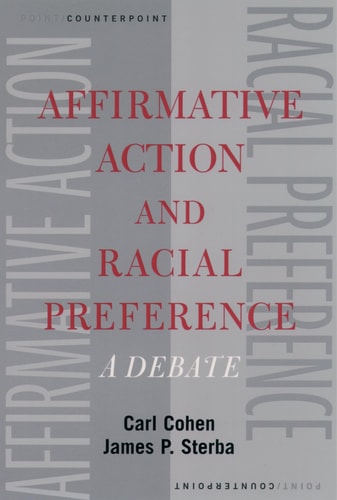
Affirmative Action and Racial Preference: A Debate
0
0
As an Amazon Associate and affiliate partner, Menrva Books earns from qualifying purchases. Learn more
Author Description
Racial preferences are among the most contentious issues in our society, touching on fundamental questions of fairness and the proper role of racial categories in government action. Now two contemporary philosophers, in a lively debate, lay out the arguments on each side.Carl Cohen, a key figure in the University of Michigan Supreme Court cases, argues that racial preferences are morally wrong--forbidden by the 14th Amendment to the Constitution, and explicitly banned by the Civil Rights Act of 1964. He also contends that such preferences harm society in general, damage the universities that use them, and undermine the minorities they were intended to serve. James P. Sterba counters that, far from being banned by the Constitution and the civil rights acts, affirmative action is actually mandated by law in the pursuit of a society that is racially and sexually just. The same Congress that adopted the 14th Amendment, he notes, passed race-specific laws that extended aid to blacks. Indeed, there are various kinds of affirmative action--compensation for past discrimination, remedial measures aimed at current discrimination, the guarantee of diversity--and Sterba reviews the Supreme Court cases that build a constitutional foundation for each. Affirmative action, he argues, favors qualified minority candidates, not unqualified ones. Both authors offer concluding comment on the University of Michigan cases decided in 2003.Half a century after Brown v. Board of Education, issues pertaining to racial discrimination continue to grip American society. Ideal for courses in political, social, ethical, and legal philosophy, this penetrating debate explores the philosophical and legal arguments on all sides of affirmative action, but also reveals the passions that drive the issue to the forefront of public life.
Menrva's Summary
THE THESIS
This book investigates the moral and legal legitimacy of affirmative action and racial preference policies within the context of American constitutional law and social justice. The authors, both established philosophers, present a structured debate that contrasts the view that racial preferences are inherently discriminatory and unconstitutional with the argument that such measures are necessary to achieve a truly equitable society. By examining historical precedents, legislative intent, and Supreme Court rulings, the text provides a rigorous framework for evaluating the competing ethical claims surrounding race-conscious policies.
THE SCOPE MAP
What You Will Find
- Analysis of the 14th Amendment and the Civil Rights Act of 1964 in relation to racial preference.
- Philosophical arguments regarding compensatory justice versus meritocratic fairness.
- Review of landmark Supreme Court cases, including the University of Michigan decisions of 2003.
- Examination of the distinction between remedial measures and diversity-driven initiatives.
THE AUTHORITY PERSPECTIVE
This text is frequently utilized in academic settings for courses in political and legal philosophy due to its balanced presentation of opposing viewpoints. Scholars and students note that the prose remains accessible while maintaining the intellectual rigor required for a complex constitutional debate.
Page Count:
416
Publication Date:
2003-09-11
Publisher:
Oxford University Press
ISBN-10:
0195148959
ISBN-13:
9780195148954
Philosophy
Non-Fiction
Law
Sociology
Ethics
Racism
Community Tags
Other Editions(2)
Similar Books













Reader Comments
Share Your Thoughts
No comments yet. Be the first to share your thoughts!