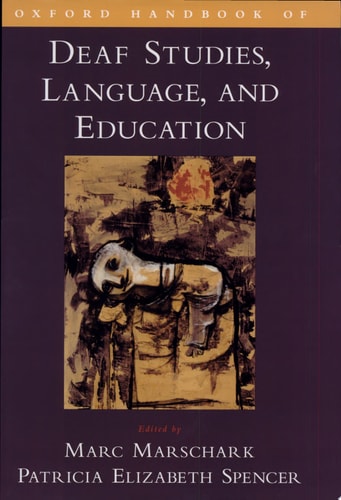
Oxford Handbook of Deaf Studies, Language, and Education
0
0
As an Amazon Associate and affiliate partner, Menrva Books earns from qualifying purchases. Learn more
Author Description
In Plato's cratylus, which dates to 360 B.C., Socrates alludes to the use of signs by deaf people. In his Natural History, completed in 79 A.D., Pliny the Elder alludes to Quintus Pedius, the deaf son of a Roman consul, who had to seek permission from Caesar Augustus to pursue his training as an artist. During the Renaissance, scores of deaf people achieved fame throughout Europe, and by the middle of the 17th century the talents and communication systems of deaf people were being studied by a variety of noted scientists and philosophers. However, the role of deaf people in society has always been hotly debated: could they be educated? Should they be educated? If so, how? How does Deaf culture exist within larger communities? What do advances in the technology and the genetics of hearing loss portend for Deaf communities?In this landmark volume, a wide range of international experts present a comprehensive and accessible overview of the diverse field of deaf studies, language, and education. Pairing practical information with detailed analyses of what works, why, and for whom, and banishing the paternalism once intrinsic to the field, the handbook consists of specially commissioned essays on topics such as language and language development, hearing and speech perception, education, literacy, cognition, and the complex cultural, social, and psychological issues associated with individuals who are deaf or hard of hearing. Through careful planning, collaboration, and editing, the various topics are interwoven in a manner that allows the reader to understand the current status of research in the field and recognize the opportunities and challenges that lie ahead, providing the most comprehensive reference resource on deaf issues.Written to be accessible to students and practitioners as well as researchers, The Oxford Handbook of Deaf Studies, Language, and Education is a uniquely ambitious work that will alter both theoretical and applied landscapes. It surveys a field
Menrva's Summary
THE THESIS
This volume investigates the multifaceted historical, social, and pedagogical status of deaf individuals to determine how contemporary research can inform more effective educational and cultural practices. Editors Marc Marschark and Patricia Elizabeth Spencer compile contributions from international experts to move beyond historical paternalism in the field. The text synthesizes data across linguistics, cognitive science, and sociology to provide a framework for understanding the current landscape of deaf studies and the implications of emerging technologies and genetic research.
THE SCOPE MAP
What You Will Find
- Comprehensive analysis of language development and speech perception in deaf populations.
- Examination of the intersection between Deaf culture and broader societal structures.
- Evidence-based reviews of literacy acquisition and cognitive development strategies.
- Discussion of the impact of technological advancements and genetic research on future community outcomes.
THE AUTHORITY PERSPECTIVE
Experts and practitioners recognize this volume as a foundational reference that successfully bridges the gap between theoretical research and applied educational practice. Readers frequently note the academic density of the prose, which serves as a primary resource for students and professionals in the field of deaf education.
Page Count:
528
Publication Date:
2003-03-27
Publisher:
Oxford University Press
ISBN-10:
0195149971
ISBN-13:
9780195149975
Psychology
Deaf education
Reference
Sign language
Education
Linguistics
Sociology
Community Tags
Other Editions(3)

Similar Books







Reader Comments
Share Your Thoughts
No comments yet. Be the first to share your thoughts!