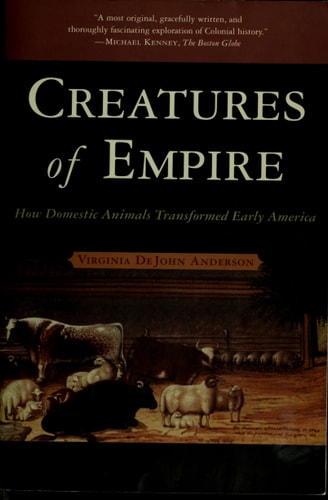
Creatures of Empire: How Domestic Animals Transformed Early America
0
0
As an Amazon Associate and affiliate partner, Menrva Books earns from qualifying purchases. Learn more
Author Description
When we think of the key figures of early American history, we think of explorers, or pilgrims, or Native Americans--not cattle, or goats, or swine. But as Virginia DeJohn Anderson reveals in this brilliantly original account of colonists in New England and the Chesapeake region, livestock played a vitally important role in the settling of the New World.Livestock, Anderson writes, were a central factor in the cultural clash between colonists and Indians as well as a driving force in the expansion west. By bringing livestock across the Atlantic, colonists believed that they provided the means to realize America's potential, a goal that Indians, who lacked domestic animals, had failed to accomplish. Settlers believed that Indians who learned to keep livestock would also advance along the path toward civility and Christian faith. But colonists failed to anticipate that the animals they hoped would convert Indians instead generated friction between the two people as Indians encountered free-ranging livestock at almost every turn, often trespassing in their cornfields. Moreover, concerned about feeding their growing populations and committed to a style of husbandry that required far more space than they had expected, colonists could see no alternative but to appropriate Indian land. This created tensions that reached the boiling point with King Philip's War and Bacon's Rebellion. And it established a pattern that would repeat time and again over the next two centuries.A stunning account that presents our history in a truly new light, Creatures of Empire restores a vital element of our past, illuminating one of the great forces of colonization and the expansion westward.
Menrva's Summary
THE THESIS
This work investigates how the introduction of European livestock served as a primary catalyst for cultural conflict and territorial expansion in early American history. Virginia DeJohn Anderson, a historian specializing in early American social and environmental history, utilizes colonial records, land-use data, and contemporary accounts to challenge traditional narratives of settlement. She argues that the colonists' reliance on free-ranging livestock necessitated constant land acquisition, which fundamentally altered the relationship between European settlers and Indigenous populations.
THE SCOPE MAP
What You Will Find
- Analysis of colonial husbandry practices in New England and the Chesapeake region.
- Examination of the role of livestock in the escalation of King Philip's War and Bacon's Rebellion.
- Documentation of the cultural and ideological clashes regarding land use and property rights.
- Investigation into the environmental impact of imported domestic animals on the North American landscape.
THE AUTHORITY PERSPECTIVE
Historians and scholars frequently cite this text as a foundational study in the environmental history of colonial America. Readers note the clarity of the prose and the author's ability to synthesize complex social and economic factors into a coherent historical argument.
Page Count:
336
Publication Date:
2004-11-15
Publisher:
Oxford University Press
ISBN-10:
0195158601
ISBN-13:
9780195158601
History
Nature
Colonization
Indians Treatment of
Human Relationships
Colonial History
History of the Americas
American History
Livestock
Social History
Environmental History
Community Tags
Other Editions(2)

Similar Books














