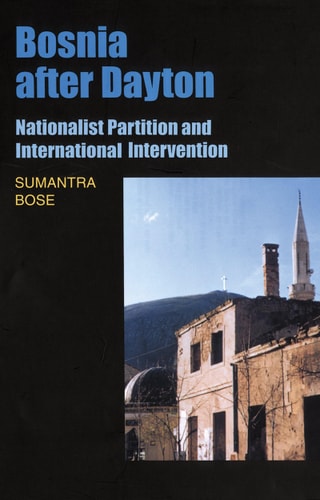
Bosnia after Dayton: Nationalist Partition and International Intervention
0
0
As an Amazon Associate and affiliate partner, Menrva Books earns from qualifying purchases. Learn more
Author Description
Since 1996, Bosnia & Herzegovina has been the site of a remarkable project of political engineering. A complex consortium of international agencies backed by Western governments have been transforming a devastated, ethnically partitioned, post-war territory into a multiethnic, democratic and economically viable state. Despite an enormous investment of personnel and resources, six years later BiHs post-Yugoslav future remains tenuous. Did the engineering project work?In an era when countries from Somalia to Afghanistan are confronting questions of state legitimacy amidst international intervention, Bosnia after Dayton is a fascinating study in the dilemmas of the post-Cold War international order. How effective are international peace-building interventions in fractured states? Is the preservation of a multinational state desirable--or even possible--where the majority of citizens only reluctantly acknowledge its legitimacy?Drawing on the authors extensive field experience, this book takes a hard look at the issues that Bosnia continues to face. Juxtaposing big-picture analysis with an intimate knowledge of the region, Bose situates the international community's extensive program of state-building and democratization in BiH since the Dayton Peace Agreement in the context of Bosnia's and the former Yugoslavia's complex historical legacy of coexistence and conflict. Bose tells the gripping story of the divided city of Mostar, and analyzes the institutional structure and process of Dayton Bosnia. He dissects the making of the Dayton peace accords through American-led coercive diplomacy, and provides a constructive critique of international peace-building.A fascinating study of democratization in a divided society, this book promises to be a landmark in the literatures on former Yugoslavia, and international intervention.
Menrva's Summary
THE THESIS
Does the international project of political engineering in post-war Bosnia and Herzegovina effectively foster a stable, democratic, and unified state? Sumantra Bose, an expert in the politics of the former Yugoslavia, evaluates the efficacy of the Dayton Peace Agreement by examining the intersection of coercive international diplomacy and the region's complex historical legacy. The book argues that the top-down imposition of state-building measures often struggles against the reality of deep-seated ethnic partition and local skepticism regarding state legitimacy.
THE SCOPE MAP
What You Will Find
- Analysis of the institutional framework established by the Dayton Peace Agreement.
- Case study of the divided city of Mostar as a microcosm of national tensions.
- Evaluation of American-led coercive diplomacy in post-conflict state-building.
- Comparative assessment of international peace-building interventions in fractured states.
THE AUTHORITY PERSPECTIVE
Experts recognize this work as a critical, evidence-based assessment of the limitations inherent in international interventionism. Readers frequently note the author's ability to balance high-level political analysis with granular, field-based observations of the Bosnian landscape.
Page Count:
352
Publication Date:
2002-09-12
Publisher:
Oxford University Press
ISBN-10:
0195158482
ISBN-13:
9780195158489
History
Politics & Government
International relations
Peace studies
Balkans
Nationalism
Bosnia and hercegovina history
Community Tags
Similar Books