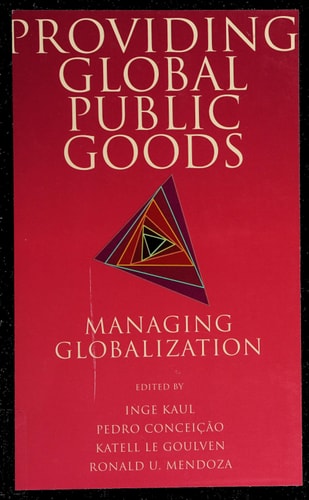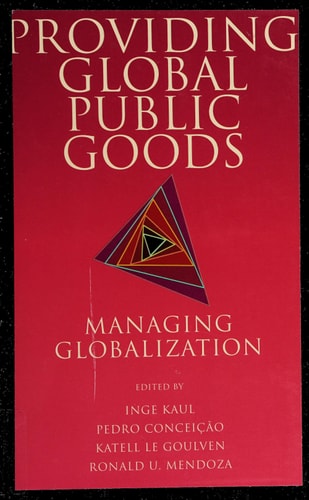
Providing Global Public Goods: Managing Globalization
0
0
As an Amazon Associate and affiliate partner, Menrva Books earns from qualifying purchases. Learn more
Author Description
Elaborating on the concepts first introduced in Global Public Goods, this book addresses the long overdue issue of how to adjust the concept of public goods to today's economic and political realities. The production of global public goods requires the orchestration of initiatives by a large number of diverse actors across different levels and sectors. It may require the collaboration of governments, business and civil society, and in most cases it almost certainly calls for an effective linkage of the local, national, regional, and global levels. In light of today's new realities, this book examines a series of managerial and political challenges that pertain to the design and implementation of production strategies and the monitoring and evaluation of global public goods provision.As participatory decision-making enhances the political support for - and thus the effectiveness of - certain policy decisions, this volume offers suggestions on a number of pragmatic policy reforms for bringing the global public more into public policy making on global issues. Nine case studies examine the importance of the global public good concept from the viewpoint of developing countries, exploring how and where the concerns of the poor and the rich overlap.Providing Global Public Goods offers important and timely suggestions on how to move in a more feasible and systematic way towards a fairer process of globalization that works in the interests of all.
Menrva's Summary
THE THESIS
This book investigates the managerial and political frameworks required to effectively produce and maintain global public goods in an increasingly interconnected economic landscape. Inge Kaul, a prominent scholar in international development, utilizes a synthesis of political theory and economic analysis to argue that traditional governance models are insufficient for modern global challenges. The text proposes a multi-level orchestration strategy that integrates local, national, and international actors to ensure equitable outcomes in the provision of essential global resources.
THE SCOPE MAP
What You Will Find
- Analysis of the shift from national to global public goods production models.
- Frameworks for multi-stakeholder collaboration between governments, private sectors, and civil society.
- Nine detailed case studies focusing on the intersection of interests between developing and developed nations.
- Pragmatic policy reform suggestions for increasing participatory decision-making in global governance.
THE AUTHORITY PERSPECTIVE
Experts frequently cite this work as a foundational text for understanding the complexities of international cooperation and policy design. Readers often note the academic density of the prose, which serves as a rigorous resource for students and practitioners of international development and political economy.
Page Count:
672
Publication Date:
2003-01-16
Publisher:
Oxford University Press
ISBN-10:
0195157419
ISBN-13:
9780195157413
Economics
International Cooperation
International relations
Public Policy
Public goods
Globalization
Community Tags
Similar Books