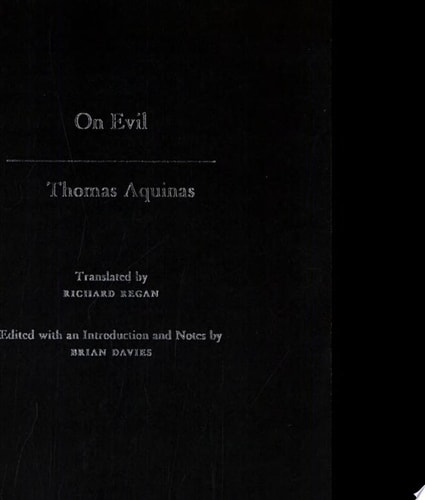
On Evil
0
0
As an Amazon Associate and affiliate partner, Menrva Books earns from qualifying purchases. Learn more
Author Description
The De Malo represents some of Aquinas' most mature thinking on goodness, badness, and human agency. In it he examines the full range of questions associated with evil: its origin, its nature, its relation to good, and its compatability with the existence of an omnipotent, benevolent God. This edition offers Richard Regan's new, clear readable English translation, based on the Leonine Commission's authoritative edition of the Latin text. Brian Davies has provided an extensive introduction and notes. (Please note: this edition does not include the Latin text).
Menrva's Summary
THE THESIS
This work investigates the ontological status of evil, specifically questioning how the existence of evil can be reconciled with the presence of an omnipotent and benevolent deity. Thomas Aquinas, a foundational scholastic philosopher and theologian, utilizes the rigorous dialectical method of the medieval university to dissect the nature of privation and human agency. By drawing upon Aristotelian logic and Christian doctrine, he constructs a systematic framework that defines evil not as a substance, but as a lack of due order or goodness within created beings.
THE SCOPE MAP
What You Will Find
- A comprehensive analysis of the origin and nature of moral and physical evil.
- Scholastic methodology involving the posing of questions, objections, and formal responses.
- Examination of human free will and its relationship to divine providence.
- Critical commentary and historical context provided by modern scholars Brian Davies and Richard Regan.
THE AUTHORITY PERSPECTIVE
Scholars and students of medieval philosophy frequently cite this text as a primary source for understanding Aquinas' mature ethical and metaphysical thought. Readers often note the academic density of the prose, which requires careful attention to the specific definitions and logical structures employed throughout the disputations.
Page Count:
560
Publication Date:
2003-01-01
Publisher:
Oxford University Press
ISBN-10:
0195158539
ISBN-13:
9780195158533
Religion
Philosophy
Good & Evil
Metaphysics
Sin
Theology
Ethics
Community Tags
Similar Books