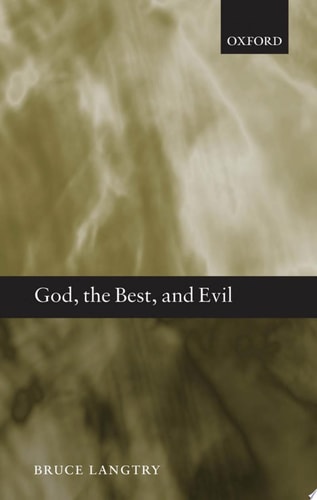
God, the Best, and Evil
0
0
As an Amazon Associate and affiliate partner, Menrva Books earns from qualifying purchases. Learn more
Author Description
God, the Best, and Evil is an original treatment of some longstanding problems about God and his actions towards human beings. First, Bruce Langtry explores some implications of divine omnipotence, omniscience, and perfect goodness for God's providence. In particular, he investigates whether God is in some sense a maximizer. Second, he assesses the strength of objections to the existence of God that are based on the apparent fact that God could have created a better world than this one. Finally, he assesses the strength of objections to the existence of God that focus on the problem of evil.To create a (possible) world is to strongly or weakly actualize it. A world is prime if God can create it, and he cannot create a world better than it. This book's conclusions include the following:BL(1) If there is at least one prime world, then if God does create some world he will create a prime world.BL(2) If there are no prime worlds, then it does not follow that God does not exist. Instead, what follows is that if God creates a world he will create one that is good enough, despite the fact that he could create a world which is better.BL(3) This conclusion does not give rise to a good objection to theism, based on the apparent fact that the actual world is improvable and yet it is not good enough.BL(4) Even if there is a best world, or several equal-best worlds, God cannot create any of them.BL(5) A good partial theodicy for evil can be provided, appealing to goods bound up with human free will, moral responsibility, and the roles of individuals' own personal traits in shaping their own and other people's lives. The partial theodicy is neutral between Theological Compatibilism and libertarianism.BL(6) The problem of evil does not provide a very strong objection to the existence of God.
Menrva's Summary
THE THESIS
This book investigates the logical consistency of the existence of an omnipotent, omniscient, and perfectly good deity in the face of the existence of evil and the possibility of a better world. Bruce Langtry, a philosopher specializing in the philosophy of religion, utilizes formal logical frameworks to analyze divine providence and the concept of a 'prime world.' He evaluates whether the existence of a potentially improvable world serves as a valid objection to theism, ultimately proposing a partial theodicy that reconciles divine nature with human free will and moral responsibility.
THE SCOPE MAP
What You Will Find
- Logical analysis of divine omnipotence, omniscience, and perfect goodness.
- Evaluation of the 'prime world' hypothesis and its implications for divine action.
- Assessment of the problem of evil as an objection to theistic belief.
- A partial theodicy grounded in human free will, moral responsibility, and personal character traits.
THE AUTHORITY PERSPECTIVE
Scholars and students of philosophy often cite this work for its rigorous, analytical approach to traditional theistic problems. Readers frequently note the technical density of the prose, which requires a strong background in modal logic and contemporary analytic philosophy to fully grasp the author's arguments.
Page Count:
256
Publication Date:
2008-08-27
Publisher:
Oxford University Press
ISBN-10:
0199238790
ISBN-13:
9780199238798
Philosophy
Religion
Metaphysics
Good & Evil
Theodicy
Ethics
Theology
Community Tags
Other Editions(3)
Similar Books

Reader Comments
Share Your Thoughts
No comments yet. Be the first to share your thoughts!