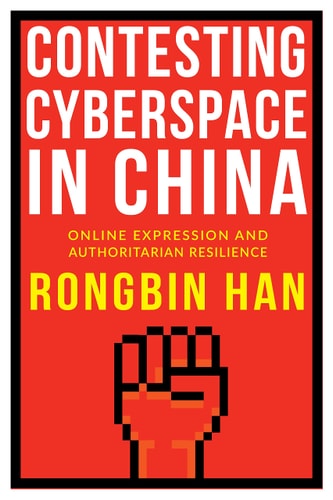
Contesting Cyberspace in China: Online Expression and Authoritarian Resilience
0
0
As an Amazon Associate and affiliate partner, Menrva Books earns from qualifying purchases. Learn more
Author Description
The Internet was supposed to be an antidote to authoritarianism. It can enable citizens to express themselves freely and organize outside state control. Yet while online activity has helped challenge authoritarian rule in some cases, other regimes have endured: no movement comparable to the Arab Spring has arisen in China. In Contesting Cyberspace in China, Rongbin Han offers a powerful counterintuitive explanation for the survival of the world's largest authoritarian regime in the digital age. Han reveals the complex internal dynamics of online expression in China, showing how the state, service providers, and netizens negotiate the limits of discourse. He finds that state censorship has conditioned online expression, yet has failed to bring it under control. However, Han also finds that freer expression may work to the advantage of the regime because its critics are not the only ones empowered: the Internet has proved less threatening than expected due to the multiplicity of beliefs, identities, and values online. State-sponsored and spontaneous pro-government commenters have turned out to be a major presence on the Chinese internet, denigrating dissenters and barraging oppositional voices. Han explores the recruitment, training, and behavior of hired commenters, the "fifty-cent army," as well as group identity formation among nationalistic Internet posters who see themselves as patriots defending China against online saboteurs. Drawing on a rich set of data collected through interviews, participant observation, and long-term online ethnography, as well as official reports and state directives, Contesting Cyberspace in China interrogates our assumptions about authoritarian resilience and the democratizing power of the Internet.
Menrva's Summary
THE THESIS
This book offers a counterintuitive explanation for the survival of China's authoritarian regime in the digital age. Rongbin Han investigates the complex dynamics of online expression in China, revealing how the state, service providers, and netizens negotiate the limits of discourse. While state censorship has conditioned online expression, it has not brought it under complete control; however, freer expression can paradoxically benefit the regime due to the multiplicity of beliefs, identities, and values online. The book details the role of state-sponsored commenters, the 'fifty-cent army,' and nationalistic Internet posters in defending China against perceived online threats.
THE SCOPE MAP
- Analysis of the negotiation of discourse limits between the state, service providers, and netizens.
- Examination of how state censorship has shaped but not fully controlled online expression.
- Exploration of the multiplicity of beliefs, identities, and values online and their impact on authoritarian resilience.
- Detailed study of the 'fifty-cent army': recruitment, training, and behavior of hired commenters.
- Investigation into the group identity formation of nationalistic Internet posters.
- Use of data from interviews, participant observation, and long-term online ethnography.
- Inclusion of official reports and state directives in the analysis.
- Interrogation of assumptions about authoritarian resilience and the democratizing potential of the Internet.
THE AUTHORITY PERSPECTIVE
The book challenges conventional wisdom regarding the Internet's role in democratizing authoritarian states, particularly in the Chinese context. It is noted for its detailed examination of the internal dynamics of online expression and the state's sophisticated methods of managing dissent. The research is grounded in extensive fieldwork, offering a nuanced perspective on how online activity can, in some instances, reinforce rather than undermine authoritarian control. This work is likely to be of interest to scholars of political science, sociology, and Chinese studies.
Page Count:
315
Publication Date:
2018-01-01
Publisher:
Columbia University Press
ISBN-10:
0231184743
ISBN-13:
9780231184748
Non-Fiction
Politics
Science & Technology
Social Science
Technology
China Studies
Community Tags
Similar Books