Ten Theories of Human Nature
0
0
As an Amazon Associate and affiliate partner, Menrva Books earns from qualifying purchases. Learn more
Author Description
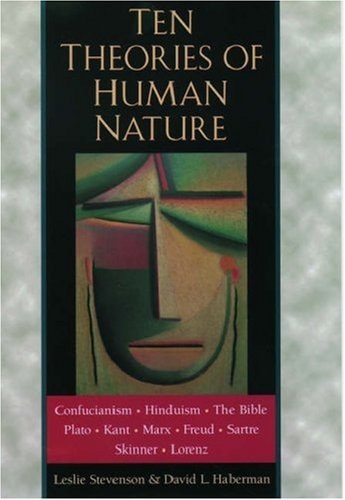
Over three previous editions, Ten Theories of Human Nature has been a remarkably popular introduction to some of the most influential developments in Western and Eastern thought. This thoroughly revised fourth edition features substantial new chapters on Aristotle and on evolutionary theories of human nature; the latter centers on Edward O. Wilson but also outlines the ideas of Emile Durkheim, B. F. Skinner, Nikolaas Tinbergen, Konrad Lorenz, Noam Chomsky, and recent evolutionary psychology. This edition also includes a rewritten introduction that invites readers (even if inclined toward fundamentalism, or to cultural relativism) to careful, critical thought about human nature; a useful new section that summarizes the history of ideas from the Stoics to the Enlightenment; and a new conclusion that suggests a way to synthesize the various theories. Lucid and accessible, Ten Theories of Human Nature, 4/e, compresses into a small space the essence of such ancient traditions as Confucianism, Hinduism, and the Old and New Testaments as well as the theories of Plato, Immanuel Kant, Karl Marx, Sigmund Freud, and Jean-Paul Sartre. The authors juxtapose the ideas of these and other thinkers and traditions in a way that helps readers understand how humanity has struggled to comprehend its nature. To encourage readers to think critically for themselves and to underscore the similarities and differences between the many theories, the book examines each one on four points--the nature of the universe, the nature of humanity, the diagnosis of the ills of humanity, and the proposed cure for these problems. Ideal for introductory courses in human nature, philosophy, religious studies, and intellectual history, Ten Theories of Human Nature, 4/e, will engage and motivate students and other readers to consider how we can understand and improve both ourselves and human society.
Menrva's Summary
THE THESIS
This book investigates the fundamental question of what constitutes human nature by examining ten influential philosophical, religious, and scientific frameworks. Authors Leslie Stevenson and David L. Haberman utilize their academic expertise to synthesize complex intellectual traditions into a coherent comparative study. By applying a consistent four-part analytical framework to each theory, they provide a structured method for evaluating how different thinkers have diagnosed the human condition and proposed solutions for its inherent problems.
THE SCOPE MAP
What You Will Find
- Comparative analysis of major traditions including Confucianism, Hinduism, and Judeo-Christian thought.
- Examination of key thinkers such as Plato, Aristotle, Immanuel Kant, Karl Marx, Sigmund Freud, and Jean-Paul Sartre.
- A structured methodology evaluating theories based on the nature of the universe, the nature of humanity, the diagnosis of human ills, and the proposed cure.
- Integration of modern evolutionary perspectives, including the work of Edward O. Wilson, B. F. Skinner, and Noam Chomsky.
THE AUTHORITY PERSPECTIVE
Experts and educators frequently cite this work as a foundational text for introductory courses in philosophy and intellectual history due to its accessible synthesis of dense material. Readers often note the clarity of the prose, which successfully distills complex theoretical frameworks into a manageable format for students and general readers alike.
Page Count:
288
Publication Date:
2099-11-30
Publisher:
Oxford University Press
ISBN-10:
0195169735
ISBN-13:
9780195169737
Philosophy
Psychology
Humanities
Human beings
Intellectual History
Philosophical anthropology
Community Tags
Similar Books